

The way organisations collect and understand feedback is undergoing significant changes. Every forward-thinking team is now trying to figure out how to use AI to make their surveys smarter, faster, and more insightful. At the heart of this is a simple but powerful question: how exactly is AI used in surveys, and what does that mean for your research process? Let's break down how AI adds the most value, and how your team can start using it effectively.
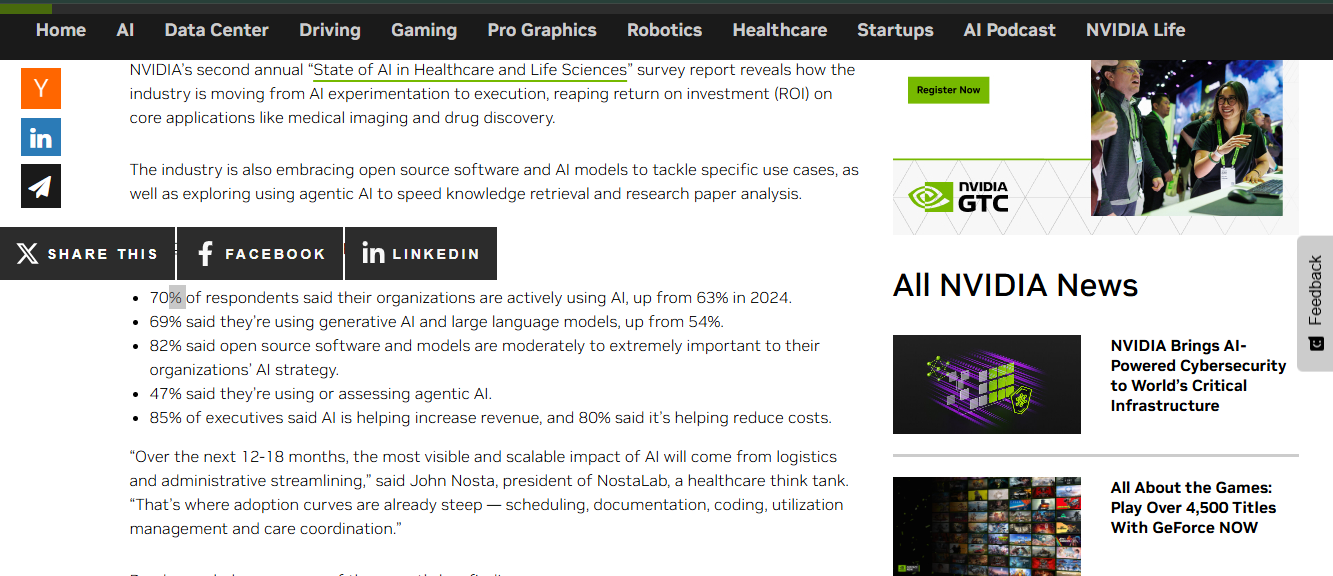
AI helps at almost every stage of the survey lifecycle, and statistical data show how beneficial it has been so far. According to the healthcare survey by NVIDIA, most top organisations that adopted AI for surveys have reported up to 78% ROI.
Contrary to some claims, it doesn't replace human judgment at the centre of good research, but it handles the heavy lifting. Let’s go into the details of how these have been achieved.
One of the most underrated areas where AI helps is survey design. Perhaps you have realized too late that your questions were ambiguous after sending out your survey. AI tools can flag these issues before the survey ever goes live.
Using natural language processing, AI can analyze your draft questions and identify problems like double-barreled phrasing and overly complex language. Also, it can rectify response options that don't cover the full range of answers respondents might want to give. This kind of real-time feedback is important, especially for CX teams running frequent surveys at scale.
Adaptive questioning is one of the most compelling applications here. Based on how a respondent answers early questions, the AI can dynamically adjust which questions come next. If someone indicates they had a poor customer experience, the survey can immediately branch into more detailed follow-up questions rather than forcing them through irrelevant sections.
If you ask respondents to answer in their own words, you will likely get unstructured, qualitative data that doesn't fit neatly into a spreadsheet. In the past, analyzing this data meant hiring a team to manually read and code every verbatim response.
However, now you can use Natural Language processing, which allows AI tools to read and classify open-ended responses automatically. It also categorises responses into themes, detects sentiment, and even identifies emerging topics.
Collecting and analysing data manually is a tedious process. You get to miss out on a lot of subtle data, even when using automation tools.
With AI-driven survey analysis tools, these limitations are history. Now AI can automatically surface statistically significant findings, flag anomalies, and highlight correlations you might not have thought to look for.
Usually, a researcher manually writes survey questions, distributes the questionnaire, waits for responses, exports the data, and then spends hours trying to find patterns. It works, but it's slow and prone to human error.
That's the radical improvement AI is making. Automation is one of the clearest and most immediate benefits of AI in surveys. Many of the most time-consuming parts of the research process can now be largely automated through AI-powered survey platforms.
Content generation with AI makes your surveys smarter. It can help tailor survey invitations and messaging to different audience segments, increasing the likelihood that respondents will actually open and complete the survey.
This kind of personalization also extends to language and tone. If your target audience spans multiple regions or languages, AI-driven translation and localization tools can ensure that your questionnaire reads naturally and accurately across languages.

Some AI survey tools like Productlogz can automatically flag low-quality responses, saving you the headache of cleaning messy data later. Let’s take a closer look at how these work.
By using the right prompts, you can describe the details of the survey you want and have the right questions ready in seconds. Also, the AI helps reduce ambiguity, bias, and other easily overlooked factors that might prevent you from getting factual feedback from your survey.
Unlike manual surveys, AI-powered surveys are built into websites, apps, and other digital platforms. This comes in handy, as questions can be formulated based on each user's behaviour.
This might just be one of the biggest flexes of AI in surveys. You can do in minutes what would usually take days and even weeks to collect, analyse, and implement. Also, every response given by a user is analysed in real time.
With manual surveys, you run the risk of exposing trade secrets to competitors. AI-powered surveys truncate this risk, and even go further to avoid sabotage by flagging low-quality responses as well.
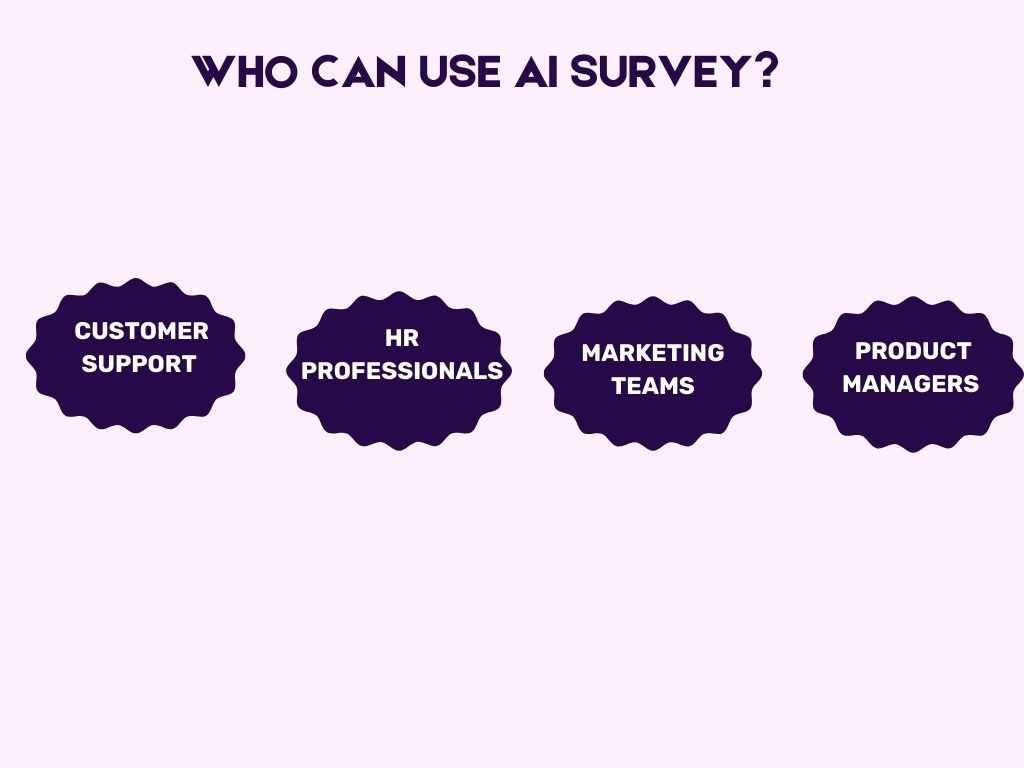
Honestly, almost anyone can use an AI survey. However, these are sectors that need to adopt these types of surveys:
If you are part of a customer support team, you will need AI-powered surveys to handle customer interactions, while also creating surveys with questions to anticipate or prevent issues.
AI-Powered surveys are useful when getting employee feedback, especially in large organisations. They also come in handy when navigating through organisational changes.
Marketing teams obviously need AI-powered surveys for customer outreach and market surveys. It helps reduce survey workload and delivery time, while also capturing data that humans easily miss.
Pre-launch testing is vital for product management teams. With AI surveys, they can get better insight into how, where, and when to launch a product.
Like any powerful tool, AI in surveys works best when used thoughtfully. Here are some best practices to keep in mind as you start or expand your use of AI for survey design and analysis.
AI is excellent at processing scale and identifying patterns, but it doesn't replace the contextual knowledge of a skilled researcher. Human oversight is essential for interpreting AI output correctly and ensuring that the insights you're acting on actually reflect reality.
AI can help you optimize survey questions, but you still need to start with a clear research objective. The better your brief, the better your AI-refined questionnaire will be.
If you're new to using AI to analyze qualitative data, spot-check the AI's coding and classification against a manual review. As you build confidence in the tool's accuracy, you can reduce the manual validation over time.
The temptation is to use AI purely to work faster, but the bigger opportunity is to use AI to improve research quality. Ask better questions, reach a more representative sample, and find insights you would have missed otherwise.
When selecting AI tools and platforms, make sure you understand how your survey data is stored and processed. In fact, when collecting sensitive customer information, you need to be confident that data remains secure and compliant with relevant privacy regulations.
Not long ago, the idea of a survey that listens, adapts, and understands how people feel as they answer would have sounded far-fetched. Now, it's just how things work. AI doesn't just speed up the process; it makes every step smarter. That means less time staring at spreadsheets, fewer questions that miss the point, and insights you can actually use.
If you want surveys that work with you instead of piling more work on you, Productlogz is built exactly for that. Everything you need is already waiting for you in one place.
What is an AI-powered survey?
An AI-powered survey uses artificial intelligence to assist with one or more stages of the survey process, including survey design, data collection, and survey data analysis.
Can AI analyze open-ended survey questions?
Yes. Using natural language processing, AI tools can automatically read, classify, and analyze open-ended responses at scale.
What are the benefits of using AI for surveys?
The main benefits include higher completion rates through adaptive design, faster and more accurate data analysis, and the ability to surface actionable insights in real time.
Do I still need human researchers if I use AI?
Absolutely. AI handles the scale and pattern recognition, but human oversight remains essential for interpreting context and setting research objectives.
No sales calls. No long setup. Create your workspace and start collecting feedback today.
