

.jpg)
If you’ve been following the tech world lately, you’ve probably noticed a massive shift. Every company is trying to build AI products, and at the heart of this revolution is a unique role called the AI product manager.
You might be wondering, is this just a fancy new title for a traditional pm? Not exactly. While there is overlap, the role of an AI PM is distinct, challenging, and incredibly exciting. Let’s break down what these AI PMS actually do, the skills they need, and how you can become one.
In simple terms, an AI product manager is a product leader who specializes in guiding the development of products that are powered by AI or AI-driven. They sit at the intersection of business goals, user experience, and complex AI technologies.
Think of a traditional product manager for a project management tool like Asana or Jira. They focus on features like task assignments, deadline reminders, and Gantt chart views. Their job is to help teams organize their workflow. Now, imagine that same tool starts doing something radically different.
What if, instead of you manually breaking down a project, the tool uses machine learning to analyze past projects and automatically generates a task list and estimated timeline?
To build those intelligent features, you need someone who understands not just the user's need to manage tasks, but the capabilities and limitations of machine learning and artificial intelligence. The traditional pm might ask, "How can we make it easier to create a task?" The AI PM asks, "Can we eliminate the need to create the task manually altogether?" Let’s go ahead to give you more insights about what they do
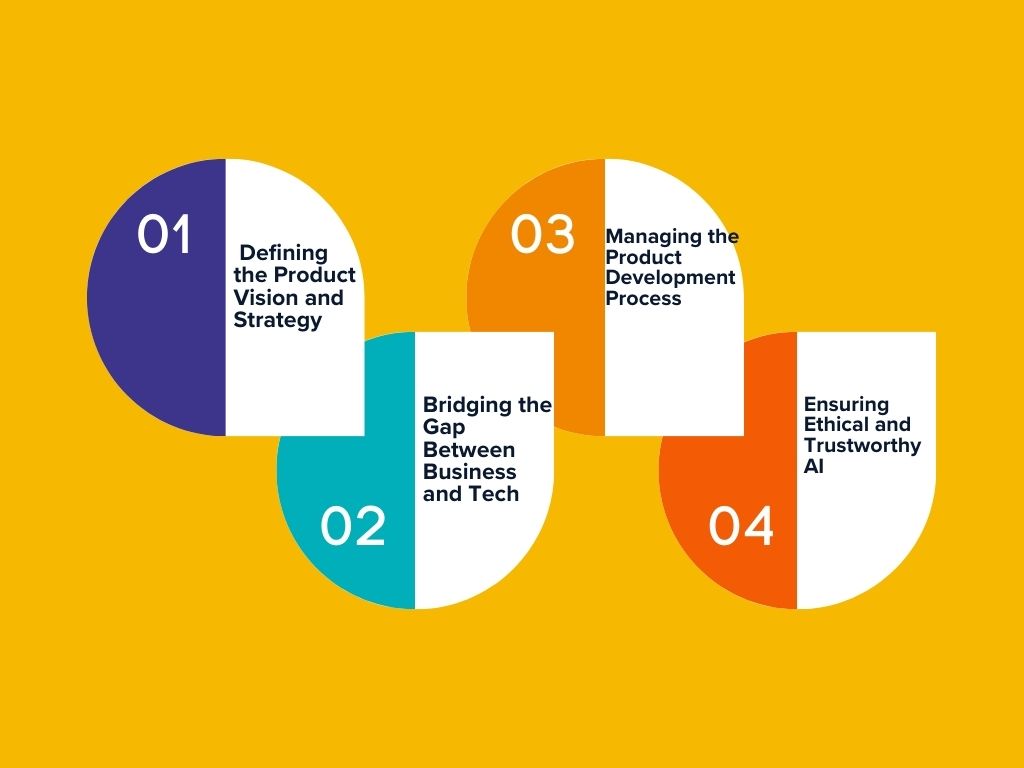
The day-to-day life of an AI PM is a mix of strategy, technical collaboration, and user advocacy. It’s less about designing every button and more about defining the "brain" behind the product. Here are some of their roles:
Just like any other PM, an AI PM starts with the "why." They explore how AI can create a better experience for the user. This involves analyzing customer feedback, studying market trends, and identifying opportunities where AI enables new capabilities. They also create a product roadmap that outlines how the team will leverage AI capabilities to achieve specific outcomes. invariably, their job is to ensure the product vision aligns with both user needs and what is technically feasible.
This is where the role gets unique. An AI PM must constantly collaborate with data scientists,and engineers. They don’t need to code, but they must understand AI enough to have meaningful conversations.
When a data scientist says, "We can build a model to predict churn with 85% accuracy," the AI PM asks, "Is 85% good enough for our users to trust it? What's the fallback plan when it's wrong?"
They translate technical possibilities into business value and vice versa. They work with cross-functional teams like engineering, design, and legal, to ensure the AI-powered systems are built responsibly.
AI product development is different from traditional software. You can't just write a spec and have it built. The behavior of AI models is learned, not programmed. Therefore, the AI PM must define success metrics for the model itself. They work with product teams to prioritize what data to collect, how to evaluate model performance, and how to handle edge cases.
With great power comes great responsibility. A huge part of the AI product manager’s job is to champion ethical AI. They must ensure the AI features are free from bias, respect user privacy, and are transparent about how they work. They ask tough questions like, "Is this AI model making unfair assumptions about a certain group of users?" This focus on ethical AI is what builds long-term user trust.
To be a successful AI product manager, you need more than just the leadership skills of a traditional pm. You need a new toolkit. Product managers must evolve, and here’s how.
You don't need a PhD, but you must be technically curious. You should be comfortable with concepts like neural networks, natural language processing, and the difference between generative AI and predictive AI. It is important that you know what large language models (LLMs) are good at and where they fail. Familiarity with AI platforms and tools like Vertex AI or other cloud AI services is also a huge plus. This knowledge helps you make informed product decisions.
An AI PM lives and breathes data. You don't just build features; you build systems that learn. You need to be skilled in data analysis and defining the right metric to track product performance. This includes both business metrics (like engagement) and model-specific metrics (like precision and recall). Apparently, you use analytics to understand how users are interacting with the AI and use that user feedback to iterate on the product design.
With so much hype around generative AI and AI agents, it's easy to get distracted. An AI PM must stay grounded in customer needs. They must look at the adoption of AI in the market and figure out what it means for their specific digital product.
Given the high demand and specialized skill set, compensation for these product manager roles is quite attractive. While salaries vary based on location, experience, and company size, AI PMs usually command a premium over traditional product management roles. Based on current market data from 2026, here’s what you can expect:
For example, a recent job posting for an AI Product Manager at Deloitte listed a range of $137,700 to $229,500.

Another for a Senior Product Manager in Agentic AI at a startup showed a range of $180,000 to $220,000. Even government roles for AI product managers are competitive, with the U.S. Consumer Product Safety Commission offering up to $187,093 for an AI-focused role.

The salary reflects the high stakes which is not surprising because these individuals are responsible for guiding the future of AI within their organizations. So, what can you do to hop on the moving train?
If you're intrigued and want to transition into this field, here’s a simple roadmap:
Let’s say you're coming from traditional product management. Start by upskilling. Take online courses on machine learning and generative AI. You don't need to be an engineer, but you need to speak the language.
Use AI tools in your current workflow. Experiment with generative AI models like ChatGPT or Claude. Try building a simple prototype using no-code AI platforms. This hands-on experience is invaluable.
In interviews, don't just talk about the tech. Talk about how you would identify the right problem for AI to solve. Discuss how you would measure success. Show that you can balance the magic of artificial intelligence with the reality of product development.
Become best friends with analytics. Learn how to analyze model outputs and user behavior. The best AI PMS are fluent in data.
The role of the AI product manager is one of the most dynamic and impactful in tech today. As AI is transforming every industry, the demand for these hybrid professionals will only grow.
Whether you're an aspiring PM or a seasoned product leader, developing these new skills and using good tools is an investment in your future. Tools like Productlogz help AI PMS to stop guessing and start building AI products people actually want.
The question isn't if AI will impact your product, but how. And the people answering that question? They are the AI product managers. Are you ready to become one?
Are product manager and AI product manager the same?
No. Both build products and work with cross-functional teams, but an AI product manager focuses specifically on products powered by machine learning or generative AI.
Is AI product manager hard?
Yes, it can be challenging. The hardest part is shaping the product vision when you're still figuring out what the AI technologies can actually do.
Does AI product manager require coding?
No, AI PMS does not code as part of their daily job. However, having a basic understanding of how machine learning and AI technologies work is essential.
No sales calls. No long setup. Create your workspace and start collecting feedback today.
