


Scroll through LinkedIn or Reddit for five minutes, and you'll find someone predicting the death of the product manager role. The headlines are loud, the comment sections are anxious, and if you're a PM, it's reasonable to wonder if your job has an expiration date stamped on it. Will AI replace product managers in 2026? Let's look at what the data, surveys, and the people building products are saying.
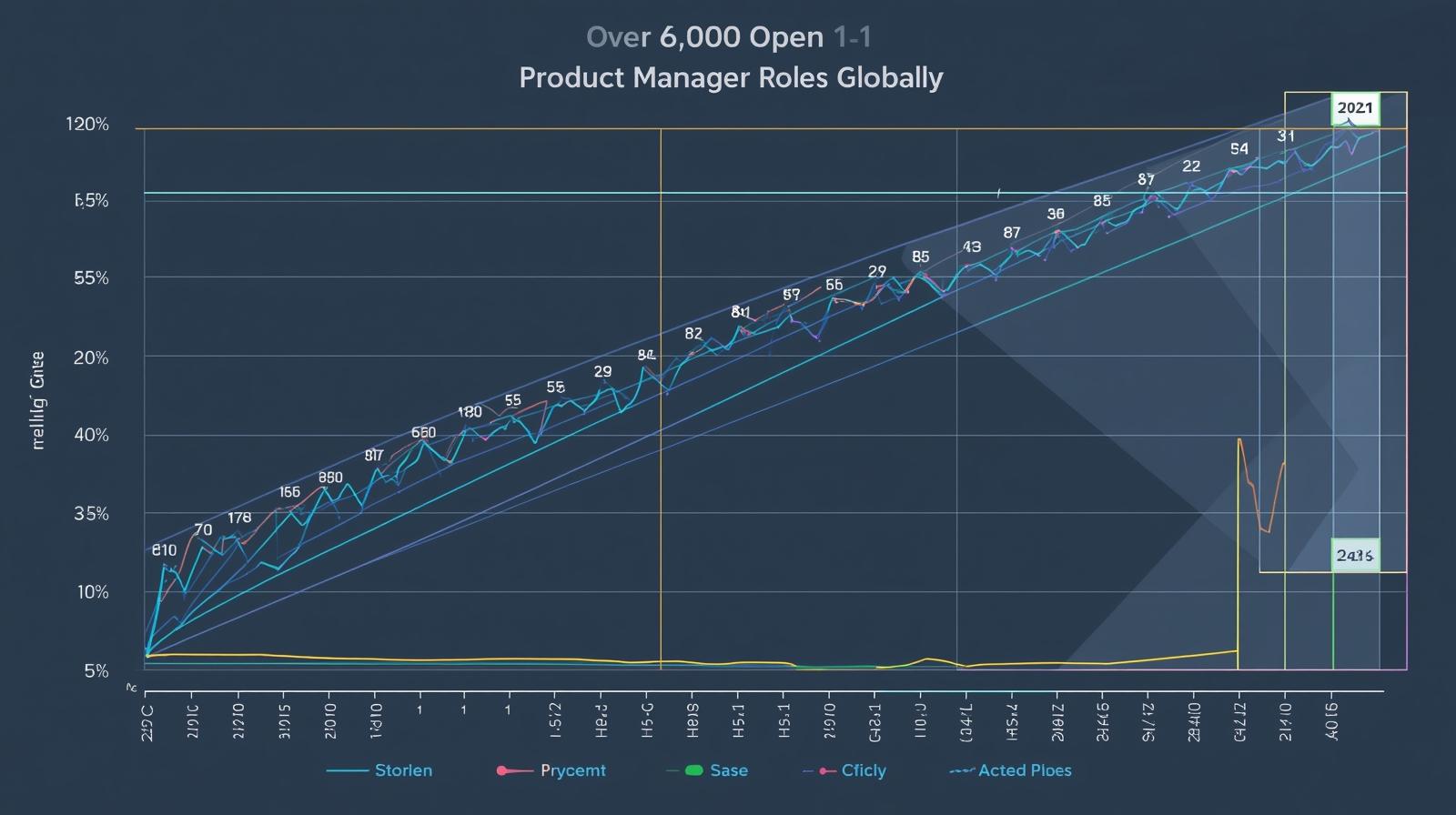
Before we dive into the panic, the good news is that the data tells a different story:
This upward trend is backed by recent industry data. In their early 2026 data release, CompTIA tracked over 275,000 active tech job postings requiring AI-related skills, noting that these requirements are rapidly absorbing traditional roles like Product Managers.
So while everyone's talking about AI replacing product managers, the demand for product managers is growing stronger. That doesn't sound like an industry about to disappear, does it?
As if the numbers were not enough, I spent some time digging through Product Management threads on Reddit, and the conversations there are way more nuanced than the scary headlines suggest.
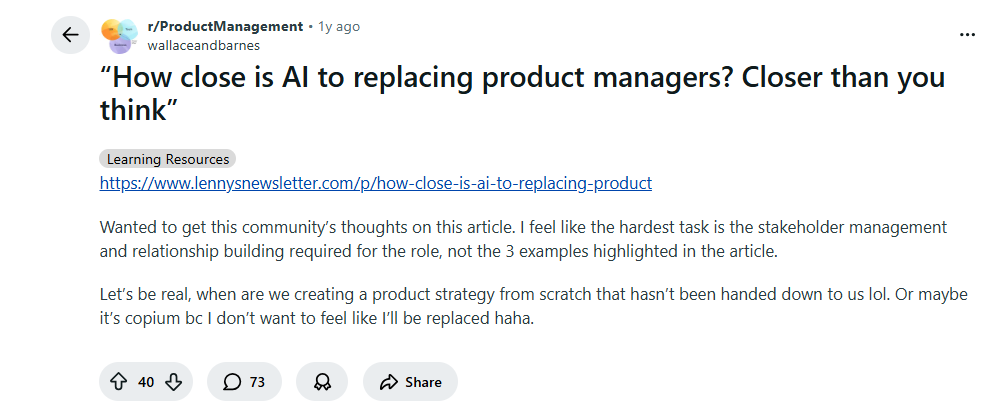
Industry veterans and leaders echo this sentiment. Shreyas Doshi, the former Stripe, Twitter, and Google product leader, puts it this way: "With some PMs, I am seeing an avoidance of AI. With others, I am seeing an over-reliance on AI to write proposals & strategies. While AI will get there eventually, right now it isn't good enough for the depth & judgment I'd expect from senior PMs."

This discussion revealed that PMs who just push tickets and echo sales requests? Yeah, they're worried. But product managers who bring real strategic thinking and user insight? They're excited about AI.
No, AI will never replace product managers in 2026. Rather, AI will replace certain tasks that product managers do. You know AI can crunch numbers, summarize feedback, and draft documents. But can it read the room in a tense stakeholder meeting? Can it build trust with your engineering team? Can it understand the unspoken needs behind what a customer is really asking for? These are questions begging for answers.
This means that the product managers who are worried right now are the ones doing surface-level work. If your day is just moving tickets around and writing basic specs, then yes, you should be concerned. But if you're the one setting vision, making tough trade-offs, and aligning teams around a common goal, you're not going anywhere. So while everyone's talking about how AI will affect product management, PMS must focus on how to use it to their advantage.
To survive and thrive, you need to know exactly which parts of your calendar are being handed over to algorithms. AI excels at repetitive, data-heavy, and structured tasks that used to eat up your day. Employees using AI report an average 40% productivity boost, with controlled studies showing 25-55% improvements depending on function.

In 2026, AI tools will fully automate or heavily streamline:
I know this sounds scary, but every single one of these outputs needs a human product manager to guide, refine, and make the final call.
On the flip side, product management forces us to think beyond just a collection of administrative tasks. There are core pillars of the role that an LLM cannot replicate because they require human consciousness, contextual awareness, and accountability. AI cannot automate:
AI doesn't get your company's mission or what shapes product manager roles and strategies. It can't sit in a brainstorming session and understand the unspoken dynamics between stakeholders. While AI can help with research, it can't replace the strategic thinking humans bring.
Sure, generative AI can analyze market trends, but crafting a compelling product vision that inspires your product team and aligns with business goals? That takes human creativity and strategic thinking. Although AI models can support, PMS to focus on visioning is still a uniquely human job.
Product management is as much about people as it is about products. You need to align stakeholders, build consensus, negotiate trade-offs, and influence without authority. AI can't read the room when tension rises between engineering and marketing, nor can it understand the subtleties of team dynamics captured in your dataset.
AI can't intuitively read between the lines in user interviews, sniff out hidden pain points, or build team trust. It processes feedback, but it doesn't feel what customers feel. It can't uncover the unstated customer needs that lead to breakthrough products.
When you're in a meeting and need to make a judgment call with incomplete information, you can't pause to ask AI. You need product sense developed through years of experience.
Hence, AI isn't capable of the nuanced decision-making that product managers handle daily. It might be your research assistant who never sleeps. But you're still the one who needs to ask the right questions, interpret the answers strategically, and make the calls that matter.
Let me explain it better using this table below:
The future of product management in 2026 isn't about AI versus humans. It's about PMs who act smarter and leverage AI versus those who don't. Here's your action plan:
Pick one repetitive task this week and find an AI tool to automate it. These tools help in summarizing customer feedback, user stories, and thrive in this new era. So, get comfortable with AI-powered solutions. Remember, AI excels at handling vast amounts of data faster than ever, but you still control the strategy.
Invest in developing soft skills like strategic thinking and communication. These are your competitive advantages in an AI-driven future. Invariably, these skills will help you understand user pain points and build relationships that cannot be automated.
Management tools like Productlogz can help you streamline feedback management and roadmap planning. It's okay to use AI for data analysis, but apply your judgment to the insights.
AI can do a lot based on the prompts you give it. The PMs who excel will be those who know how to extract value from AI-powered tools by framing problems correctly. Also, practice framing problems in ways that uncover real insights. Think of AI as your research assistant, but you still need to direct the research.
AI might create your spec, but only you can set the product vision that resonates with users and aligns with business strategy. Focus on being the strategist your team needs. Your role is to prioritize, align, and add value to the product strategies that matter.
We all know that AI can analyze data, but it can't replace the insight you get from actually talking to customers. I'll advise that you double down on user research and traditional product management.
Will AI replace product managers in 2026? No. But it will change product management forever. The PMs who'll struggle are those treating AI as a threat instead of a tool. PMS who thrive are those who embrace AI to work smarter, while learning new skills. As one veteran PM put it: "You're actually not in danger of losing your product manager jobs to AI, but rather to someone who can use AI better than you.”
Now, noting that AI is a tool, not a threat, is the mindset shift you need. The choice is yours, and you don't have a lot of time on your hands.
What PM tasks will AI automate?
Documentation, summaries, reporting, backlog organization, and data analysis
Which PM skills are irreplaceable?
Empathy, strategy, communication, leadership, product vision, and decision-making.
How can PMs stay relevant in this age of AI?
Use AI tools, strengthen human skills, stay close to customers, and improve product sense.
Should future PMs learn AI?
Yes. Not advanced coding. But AI usage, prompting, and AI-assisted workflows
Is AI product manager a good career?
Yes, becoming an AI Product Manager is a smart career move. Demand for the role has grown over 400%, the pay is strong, and it's a role that's likely to stay relevant for a long time.
What is the salary of Product Manager in AI?
In 2026, the salary for an AI Product Manager commands a clear 15% to 30% premium over traditional product management roles.
Do AI product managers need a technical degree?
No, you do not need a computer science or technical degree to be a successful AI Product Manager.
Will PM be replaced by AI?
No, AI will not replace product managers. However, AI will completely dismantle and automate the administrative layer of product management.
No sales calls. No long setup. Create your workspace and start collecting feedback today.
