Top 7 Canny Alternatives for customer feedback [2026]
Priyanka
July 29, 2026
•
5 min read
If you're finding that Canny isn't quite meeting your feedback management needs, you're not alone. With some great feedback management tools out there, there is no obligation to use a tool that may not match your requirements or fit into your budget. In this blog post, I will be laying out some of the glaring reasons why you should look out for a Canny Alternative and some better alternatives out there that can match your needs & preferences.
Why Do You Need a Canny Alternative?
Whether it's cost, interface complexity, or wanting deeper analytics, there are real reasons teams go looking for something else. They are:
1. Expensive Paid Plans
Canny now bills primarily by tracked users (anyone with a post, vote, or comment attributed to them) rather than a flat team price. The free plan is pegged at 25 tracked users, Core starts around $19/month, and Pro starts around $79/month. However, both climb fast as your user base grows, reaching several hundred dollars a month once you cross a few hundred tracked users. For an early-stage startup, that's a moving target rather than a fixed line item..
2. Only Works for Qualitative Ccustomer Feedback
Canny takes in feature requests and votes, but it has no built-in way to run NPS, CSAT, or micro-surveys. If you need quantitative signal alongside qualitative requests, you're paying for a second tool.
3. Difficult User Interface
One of the common issues faced by users with Canny is its complicated UI. The User Interface is very challenging and one may find it difficult to navigate and get used to its different user experience across sections. One example is creating a post under Feedback vs creating a post under Changelong. Both have different structures for editing & previewing and it can be a challenge for first-time users.
4. Doesn't Provide in-depth analytics
While Canny is a great feature request voting board tool, it doesn't provide in-depth analytics for the feedback collected and the progress made on the product based on the feedback. Canny claims itself as a tool that helps you analyse feedback to make better product decisions with customer feedback.
However, it does not provide any analytics on how one can improve on making better product decisions basis the feedback shared over time. A good feedback tool would also enable integrations with a product analytics tool that helps you analyze your feature adoption over time.
5. Unable to Close the Feedback loop
Canny incorporates a changelog functionality, allowing you to communicate updates regarding new features and send automated notifications to your customers when a new feature is developed.
However, Canny lacks the convenience of in-app notifications or easily sending personalized notifications to customers notifying them that their requested feature has been implemented and increasing adoption.
To achieve this, you would find yourself engaged in either onboarding another platform or spending a considerable amount of copying and pasting. Meanwhile, if closing the feedback loop matters to you, take a look at how Productlogz handles it in this Canny vs Productlogz comparison.
Quick Comparison Table
Although Canny remains one of the most recognized feedback management tools, it's no longer the only option. Several alternatives now offer similar core features at a lower price point, while others focus on advanced analytics, customer surveys, or enterprise product planning. In the table below, we'll compare each platform so you can make an informed decision:
Tool
Starting Price
Free Plan?
Roadmap
Changelog
Quantitative Feedback (NPS/CSAT)
In-Depth Analytics
Best For
ProductLogz
$19/mo
✔
✔
✔
✔ In-app surveys
✔
Small teams & startups wanting an affordable all-in-one platform.
Canny
$79/mo (Pro)
Yes (25 tracked users)
✔
✔
✖
Basic
Teams that value brand recognition and don't mind scaling costs.
Savio
$39/mo
✖
✔ (MRR-weighted)
✖
✖
Basic
Teams consolidating feedback from many different sources.
Productboard
$19/maker/mo
Yes (limited)
✔
✖
✖
✔
Larger product organizations with formal prioritization workflows.
Upvoty
$15/mo
No (14-day trial)
✔
✔
✖
Basic
Teams wanting unlimited users on a flat-rate plan.
Frill
$25/mo
✖
✔
✔
✖
Basic
Small teams looking for a simple and lightweight feedback board.
Zonka Feedback
Custom pricing
✖
✔
✔
✔ Full survey suite
✔
Mid-market and enterprise CX teams needing omnichannel feedback.
Nolt
$29/mo
✖
✔
✖
✖
Basic
Very small teams that only need a simple voting board.
UserVoice
Custom pricing
✖
✔
✖
✖
✔
Large enterprises with dedicated budgets and procurement teams.
Top Canny Alternatives in 2026
1. ProductLogz
ProductLogz is an affordable canny alternative that doesn't burn hole in your pocket and has rich feature sets that allow you to optimally collect feedback, create roadmaps & communicate product Announcements.
Features:
A feedback management tool that helps collect user feedback in one place with unlimited boards
Compared to Canny has a better & cleaner UI
Detailed in-depth analytics on user feedback received and Roadmaps created & completed over time
Ability to collaborate with team members & ensure transparency with Public Roadmaps
Embeddable Feedback & Changelog widgets that help capture feedback and share product updates within the application
Ability to Reward users for completing surveys
Ability to add rule-based in-app micro-satisfaction surveys
Ability to add a custom domain for feedback portals
Pros:
Unlimited feedback boards
Integration of a feedback & changelog capture widget directly on your website.
In-app Product Announcements!
In-app rule-based satisfaction surveys
Affordable for small business & early age start-ups
Priority customer support for all paid plans
Cons:
Lacks user segmentation but it is already on the Roadmap and will be released soon.
Lacks a simplified one-click Canny importer for hassle-free feedback transition, but the team is very proactive and will enable a seamless transition in no time.
Smaller integration list than more established players. So, if your workflow depends on a specific niche integration, check the current list before committing.
Pricing
Productlogz offers a free plan that has all the essential features one needs to collect & manage feedback for a single workspace and a team with 5 product managers or members. Compared to what Canny offers Productlogz has affordable prices in its paid plans. Its pricing plans start at only 19$ for premium features & additional workspaces.
2. Savio
Savio is a user feedback management & prioritization tool that stands out for its ability to flexibly bring in feedback scattered across different platforms.
Key Features:
Ability to Import feedback seamlessly from various sources, including integrations, email feedback, voting boards, and feedback forms.
Robust segmentation capabilities enable a clear understanding of customer preferences and desires.
Voting board settings are designed to minimize feedback bias, promoting fairness and impartiality.
A flexible road mapping tool provides a visual representation of the number of requests and Monthly Recurring Revenue (MRR) for each feature. This aids in justifying and making informed decisions about the product roadmap.
Pros:
Teams can easily contribute feedback through diverse channels, fostering a collaborative approach.
Segmentation features can help you identify and prioritize high-impact features based on customer needs.
Optional voting boards prevent bias in feedback collection, maintaining fairness and transparency.
Cons:
The lack of a changelog tool may limit your ability to communicate updates and changes to users effectively.
No tool to collect quantitative feedback.
Pricing
Pricing starts at $39/month.
3. ProductBoard
ProductBoard is a product management tool that allows product teams to understand customer needs, prioritize future developments, and foster alignment around a unified roadmap.
Key Features:
Help you collect feedback through various platforms like Zendesk, Slack etc.,
Helps you understand the needs of your most important customers with sorting, filtering, and segmentation.
Validate concepts via a public voting board.
Has tools for analysis and prioritization of features.
Pros:
Its Integration capabilities enable a seamless product feedback collection from a variety of software tools.
Can prioritize build based on impact and effort, aiding strategic decision-making.
Both teams and customers can be aligned through the display of features on a public roadmap.
Cons:
Pricing is per "maker" (anyone actively creating/prioritizing content), so costs scale quickly with team size.
Doesn't have a changelog or product announcement feature and may therefore pose challenges in closing the feedback loop efficiently.
Doesn't have a module to track quantitative feedback like micro-surveys NPS or customer satisfaction scoring
Pricing
Free plan available with limited feedback notes and one workspace. Paid tiers starts at $19/month.
4. Upvoty
Another alternative to Canny is Upvoty which stands out as a product feedback management tool designed to facilitate feedback collection through both a board with a custom domain and a widget seamlessly embedded within your product.
Key Features:
Feedback boards
Website widgets
Roadmap
Changelog
Pros:
Single sign-on functionality enhances user experience.
Custom CSS feature enables extensive customization of your feedback portal's appearance.
The ability to merge posts streamlines content management.
Empowers users to vote on behalf of others.
Cons:
Absence of feature prioritization functionality.
The simplistic nature of the roadmapping feature may not meet the needs of larger product teams.
User-based pricing could be perceived as expensive.
Doesn't have a module to track quantitative feedback like micro-surveys NPS or CSAT scoring
Doesn't have an in-depth analytics module
Pricing
With Upvoty's Power plan, you can access unlimited boards at a monthly cost of $15. Whether that's the right fit really depends on your workflow, something most comparison posts skip over. We tried to be upfront about that in our Upvoty vs Productlogz comparison.
5. Frill
Boasting a good UI, Frill positions itself as a great alternative to Canny as a user-friendly feedback collection board and widget, streamlining the process for customers to contribute ideas and vote on prioritization.
Key Features:
Feedback voting board and widget
Idea and comment management
Customer-centric roadmap with views and comments
Changelog functionality
Multilingual support
Pros:
Ability to import feedback from platforms such as Zendesk and Intercom.
Integration of a feedback capture widget directly on your website.
Simplified one-click Canny importer for hassle-free feedback transition.
Cons:
Limited flexibility in integrating feedback from various applications.
Minimal segmentation options are available.
Doesn't have a module to track quantitative feedback like micro-surveys NPS or CSAT scoring
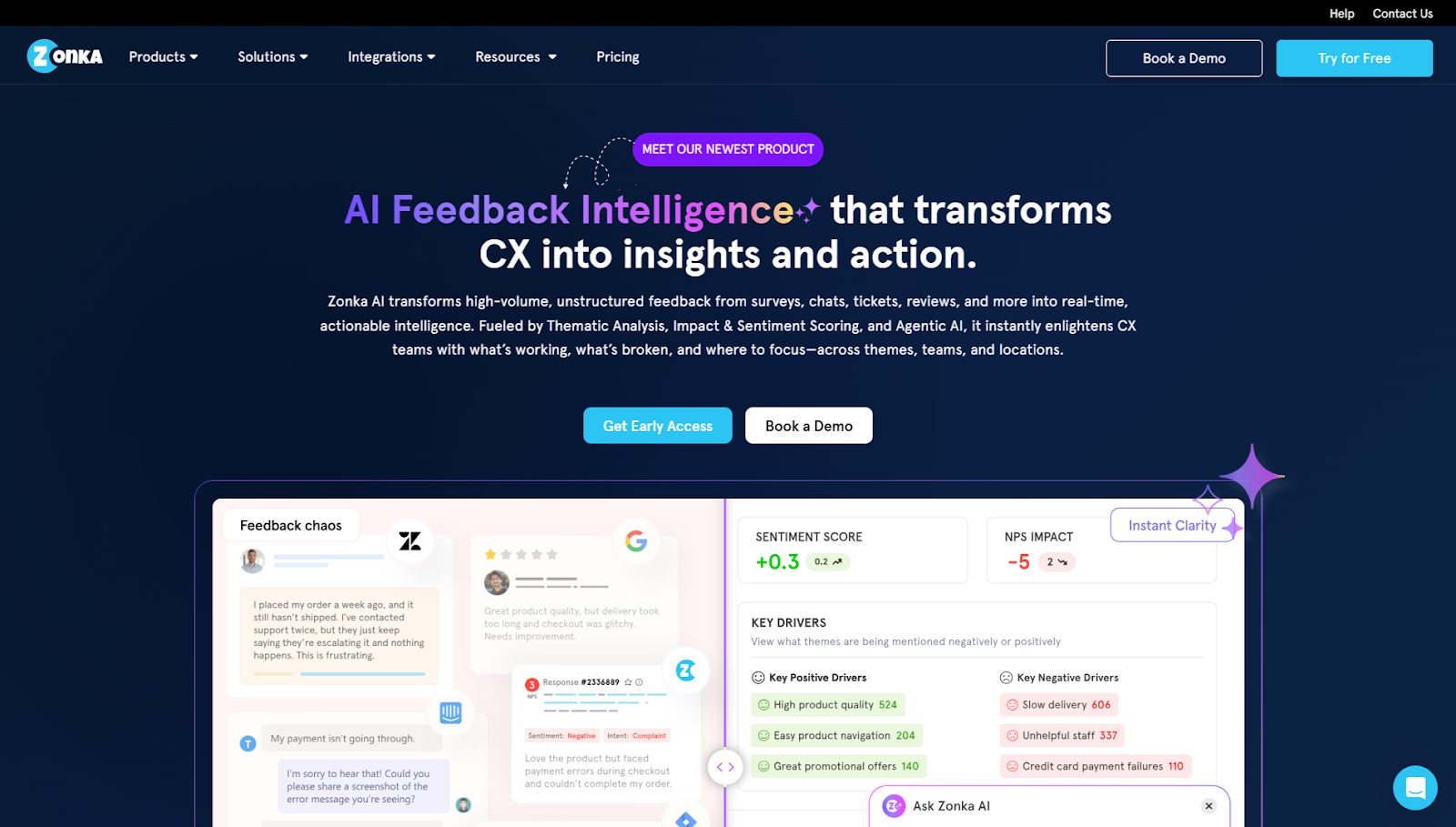
Zonka Feedback is an AI-powered Canny alternative built for SaaS teams that want to go beyond feature upvotes. It combines product feedback collection, survey-based insights, and closed-loop workflows in one powerful platform—so you can capture what users want in the moment, analyze it with AI, and act fast to build better product.
Key Features:
Centralized product feedback inbox with multi-channel capture (in-app, email, widgets)
AI-powered sentiment, emotion, and urgency detection to cut noise
Dynamic user segmentation for precise targeting and prioritization
In-app microsurveys (NPS, CSAT, CES) and visual feedback widgets
Public roadmaps and changelogs to share progress and close the loop
Automated workflows to assign feedback, trigger alerts, and follow up
JavaScript SDK for flexible survey deployment and event-based targeting
Native integrations with Jira, HubSpot, Salesforce, Intercom, and 1000+ tools
Pros:
Helps teams prioritize improvements with AI-driven themes, sentiment, and impact scoring
Provides deep analytics across survey data, reviews, tickets, and experience signals for clearer, data-backed decisions
Smart targeting and throttling prevent feedback fatigue
Enables seamless collaboration between CX, product, marketing, engineering, support, and operations through a unified inbox and case management
Offers powerful automation and real-time alerts to speed up response and resolution
Supports omnichannel feedback collection, including NPS, CSAT, CES, and in-app micro-surveys
Cons:
No native voting board style upvote UX (but captures feature requests via widgets and surveys)
Some advanced AI capabilities and integration options require higher-tier plans
May feel feature-rich for very small teams that only need simple forms
Pricing
Zonka Feedback offers flexible pricing for SMBs and enterprises alike, with affordable plans for growing teams and advanced enterprise options that include SSO, HIPAA, and custom data controls—making it a strong alternative to tools like Canny for end-to-end customer experience and feedback management.
7. Nolt
Nolt distinguishes itself with its primary feature, the feedback boards, providing a collaborative space for user requests. While lacking changelog features, Nolt serves as a viable alternative to Canny for feedback collection and roadmap management, complementing functionalities provided by tools like Canny & Savio.
Key Features:
Feedback idea boards
Roadmaps
Anonymous voting
Voting on behalf of others
Pros:
No user registration required for participation.
Multilingual support for a diverse user base.
Seamless integration with Jira, Trello, Slack, Discord, and more.
Single sign-on functionality enhances user experience.
Custom branding options for personalized user engagement.
Cons:
Absence of a changelog or announcements feature.
Inability to import feedback from external sources like Intercom.
Doesn't have a module to track quantitative feedback like micro-surveys NPS or CSAT scoring
Pricing is per-board rather than per-team. Moving from one board to five roughly doubles the bill
Pricing
Plan start at $29/month
One Extra Canny Alternative
8. UserVoice
UserVoice is a feedback management tool that provides a robust solution for gathering feedback from diverse sources. Particularly well-suited for large enterprise SaaS companies, UserVoice extends its functionality beyond customer feedback to encompass inputs from internal teams.
Key Features:
Feedback portal for comprehensive input collection.
Ability to gather feedback seamlessly from Slack, a feedback widget, and through API integration.
Feedback analysis tools for in-depth insights.
Roadmap functionality for strategic planning.
Internal status updates to keep all teams informed.
Pros:
Facilitates the prioritization of features based on user feedback.
Offers insightful analytics on the submitted feedback, aiding data-driven decision-making.
Promotes collaboration across various teams, including product, marketing, engineering, sales, and customer success.
Cons:
Lacks a changelog or announcements feature.
The absence of affordable subscription options may be a drawback for small businesses.
Doesn't have a module to track quantitative feedback like micro-surveys NPS or CSAT scoring
Pricing
Tailored specifically for enterprise solutions, UserVoice offers custom pricing
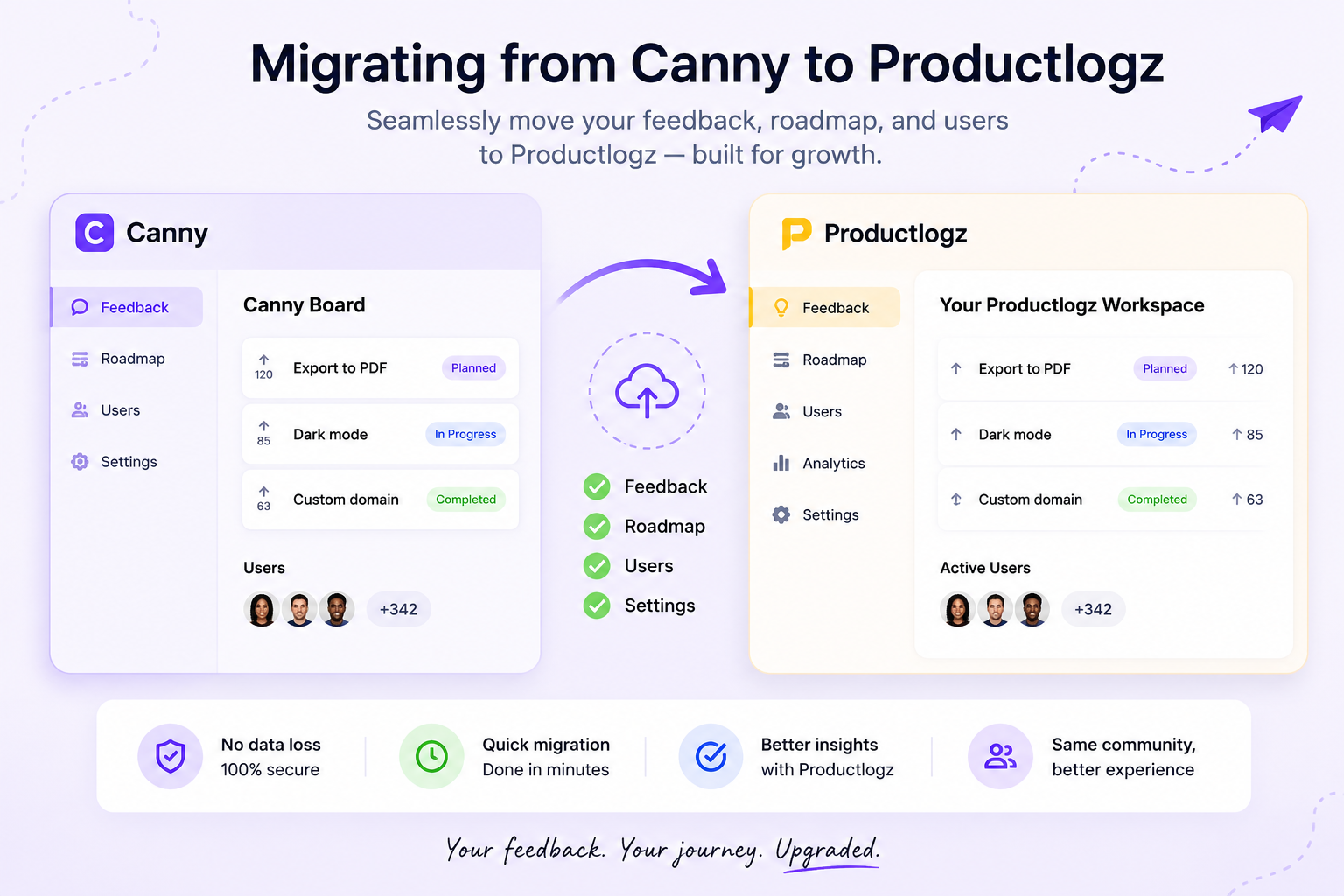
How to Migrate From Canny to ProductLogz
Switching from Canny doesn't have to be complicated. Most modern feedback management platforms like Productlogz make migration fairly straightforward. Here's what it would look like:
Export your data from Canny. In Canny, go to Settings → Export and pull your posts, comments, votes, and boards as CSV. Canny doesn't offer a one-click migration out, so plan for a manual export step.
Map your boards. List out your existing Canny boards (e.g., "Feature Requests," "Bugs") and create matching boards in ProductLogz before importing, so posts land in the right place.
Import your posts. Use ProductLogz's import tool to upload your exported CSV. Since ProductLogz doesn't yet have a dedicated one-click Canny importer, expect to do light cleanup on column mapping (post title, description, vote count, status) during import.
Recreate your roadmap statuses. Match your Canny status columns to ProductLogz's roadmap so in-flight items don't lose their place..
Embed the new widget. Swap Canny's embedded feedback/changelog widget script for ProductLogz's on your site or in-app, and test it in staging before pushing to production.
Redirect and announce. Set up a redirect from your old Canny board URL if it was public-facing, and send a short note to active users letting them know where to find the new board.
Cancel Canny only after a parallel-run period. Keep Canny live (even on the free tier) for 2–4 weeks after cutover so you can catch anything that didn't migrate cleanly before fully closing the account.
Conclusion
If you are looking for an alternative for Canny in 2026, above are some of the few good options you can explore basis your company structure & requirements. If you are a small business owner with a team of less than 3, the Productlogz comes out as one of the top alternatives as it offers a generous free plan. If you are an enterprise that requires advanced security & premium collaboration features with the tools being used in your company, UserVoice would be a great choice for you.
Share this post
Priyanka
July 29, 2026
•
5 min read
Simplifying Feedback Management for SaaS
Ready to get started?
No sales calls. No long setup. Create your workspace and start collecting feedback today.