


As an entrepreneur or business owners, we are often looking to create a successful product or service. But has anyone actually told you they'd pay for it? That's what customer validation is really about, and skipping it is one of the most expensive mistakes a founder can make. In this guide, we'll walk you through the 7 steps of customer validation, and give you a framework you can use right away.
Customer validation is the process of testing and validating your product or service idea with your target customers.
It involves collecting feedback and insights from potential customers to ensure that your product or service meets their needs and solves their problems. The purpose of customer validation is to reduce the risk of creating a product or service that nobody wants to buy.
So, why should you even bother about customer validation? For starters, it helps you to understand your customers' needs and preferences.
By validating your product or service with potential customers, you can identify any flaws or weaknesses in your idea and make necessary improvements before launching. This saves you time and money in the long run and increases the likelihood of success.
You can have a great product idea and still struggle to get customers. Why? Because having an idea isn't the same as knowing that people actually need it.
The Customer Validation Framework helps you find out if you're solving a real problem for founders. It pushes you to move beyond assumptions and look at what customers are actually saying and doing.
It focuses on four things: understanding the problem your customers are dealing with, making sure your solution genuinely helps them, finding out whether they're willing to pay for it, and proving that you can consistently find more people with the same problem.
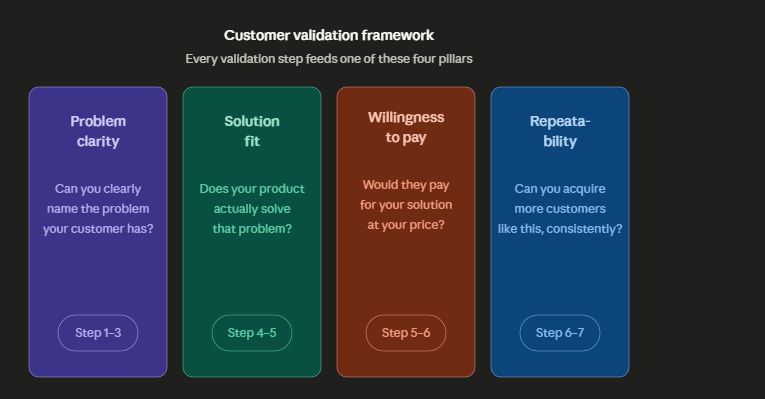
A lot of businesses fail because they build products based on what they think customers want. Customer validation helps you avoid that mistake. Instead of relying on opinions, you gather evidence that people need your solution and see enough value in it to pay for it.
Customer validation is often confused with market validation, but they are two different concepts.
Market validation involves assessing the market demand for your product or service idea. It focuses on the size of the market, the competition, and the overall demand for your product or service.
Customer validation, on the other hand, focuses on the specific needs and preferences of your target customers.
While market validation is important, customer validation is critical to the success of your product or service.
It ensures that your product or service meets the needs of your target customers and solves their problems. Without customer validation, you risk creating a product or service that nobody wants to buy, regardless of market demand.
The following are important steps that will help you in your customer validation process:
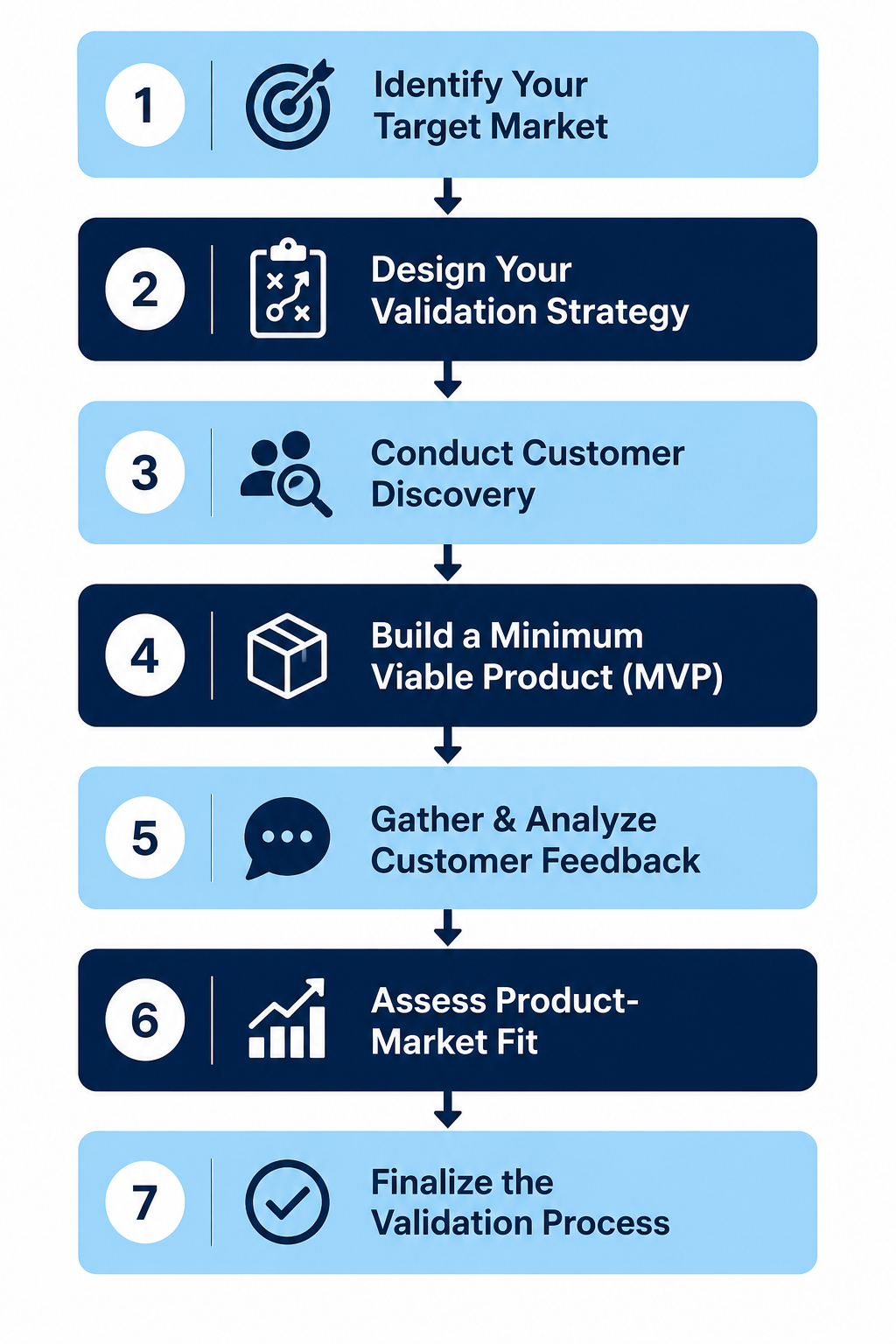
Before you can begin the customer validation process, you need to identify your target market.
This means defining the specific group of people who are most likely to be interested in your product or service.
Here are two important steps to follow when identifying your target market:
To define your target customer, you need to consider factors such as age, gender, income, location, and interests.
By creating a detailed profile of your ideal customer, you can better understand their needs and preferences, and tailor your product or service accordingly.
For example, if you're building a project management tool for remote teams. Your target customer isn't "anyone who works remotely." It's a 35-year-old engineering manager at a 20–50 person startup, frustrated that Jira is too heavy and Trello is too simple. By understanding this demographic, you can create marketing materials and messaging that will resonate with them.
Once you have defined your target customer, you need to analyze the size and share of your market.
This means determining how many people fit your target customer profile, and how many competitors you have in your industry. Market research is an important tool for analyzing market size and share.
You can use surveys, LinkedIn research, industry reports, and even competitor reviews on G2 or Capterra to map this out This information can help you identify gaps in the market, as well as areas where you can differentiate your product or service.
When it comes to customer validation, designing a solid validation strategy is crucial to the success of your business. A validation strategy is a plan that outlines the steps you will take to validate your business model and value proposition. Here's how to get it done:
The first step in designing your validation strategy is to develop a business model.
Your business model is the foundation of your business and outlines how you will create, deliver and capture value.
To develop your business model, you should consider the following:
Once you have a clear understanding of your business model, you can begin to develop your validation strategy.
Your value proposition is a statement that outlines the unique value your product or service provides to your customers. To create a strong value proposition, you should consider the following:
With a clear understanding of your value proposition, you can begin to design your validation strategy to test your assumptions and validate your business model.
Before launching a new product or service, it's important to conduct customer discovery to ensure that you are meeting the needs of your target audience.
The customer discovery phase involves researching and understanding your target market, identifying their pain points, and determining how your product or service can solve their problems.
To begin the customer discovery process, you should start by creating a list of potential customers and conducting market research to identify their needs and preferences.
This can be done through:
These methods allow you to gather feedback directly from your target audience and gain insights into their needs and preferences. When interviewing, follow these rules:
Surveys are another effective way to gather feedback from your target audience. When creating a survey, keep them short (under 5 minutes), ask only what you need, and consider using tools like Productlogz's in-app surveys to gather micro-survey responses and incentivize participation.
You can use this template for your discovery interviews:
Pre-Interview
Core Questions
Closing
An MVP is a product with just enough features to satisfy early customers and provide feedback for future product development.
Here are two critical steps to consider when building an MVP.
The product development process is the sequence of steps that a company follows to develop a new product or service.
It includes idea generation, market research, product design, testing, and launch. To determine which features to include in your MVP, start by identifying the problems your target customers are facing.
Then, brainstorm solutions to those problems and prioritize the most critical features. Consider using a feedback management & roadmap tool or feature matrix to help you organize and prioritize your features.
For example, Dropbox didn't build the full product first. They made a demo video explaining the concept, measured signups, and validated demand before writing a single line of real code. Your MVP doesn't even have to be a product, it can be a landing page, a prototype, or a manual process.
Iterative product development is a process of continually refining and improving a product based on feedback from customers.
Consider using tools like A/B testing, surveys, and user testing to gather feedback and insights. Use this feedback to refine your product and make improvements. Keep iterating until you have a product that meets the needs of your target customers.
One of the most important steps in the customer validation process is gathering and analyzing customer feedback.
This step involves conducting customer validation interviews and using the feedback obtained to improve your product.
To conduct these interviews, you need to identify your target audience and reach out to them.
You can use various methods such as social media, email, support or in-person meetings to reach out to your target audience. Once you have identified your target audience, you need to prepare a set of questions that will help you gather relevant information about their needs and preferences.
During the interview, it is important to ask open-ended questions that encourage the customer to provide detailed feedback. For example, instead of asking questions like : How did you like our excellent service, ask this: How did you like our service?
After the interview, you should analyze the feedback obtained and identify common themes or patterns. This will help you understand your customer's needs and preferences better.
Once you have gathered customer feedback, the next step is to use it to improve your product.
You should analyze the feedback obtained and identify areas where your product can be improved. This may involve making changes to the product's features, design, or functionality.
→ Read more: How to Collect and Manage Customer Feedback Effectively →
Here are two steps to help you assess your product-market fit:
Product-market fit is that feeling when customers are pulling the product out of your hands faster than you can build it. But before you get there, you need to honestly assess whether you're close.
Ask yourself:
The "40% rule" popularized by Sean Ellis is a useful benchmark. If at least 40% of your surveyed users say they'd be very disappointed without your product, you likely have product-market fit.
If you find that your product does not meet the needs of your target market, you may need to adjust it to meet their needs. This could involve making changes to the product design, pricing, or marketing strategy.
Let look at Slack as our example. Slack originally launched as a gaming company's internal tool. When the game flopped, they noticed the chat tool was the thing people loved. They pivoted entirely, found product-market fit, and the rest is history.
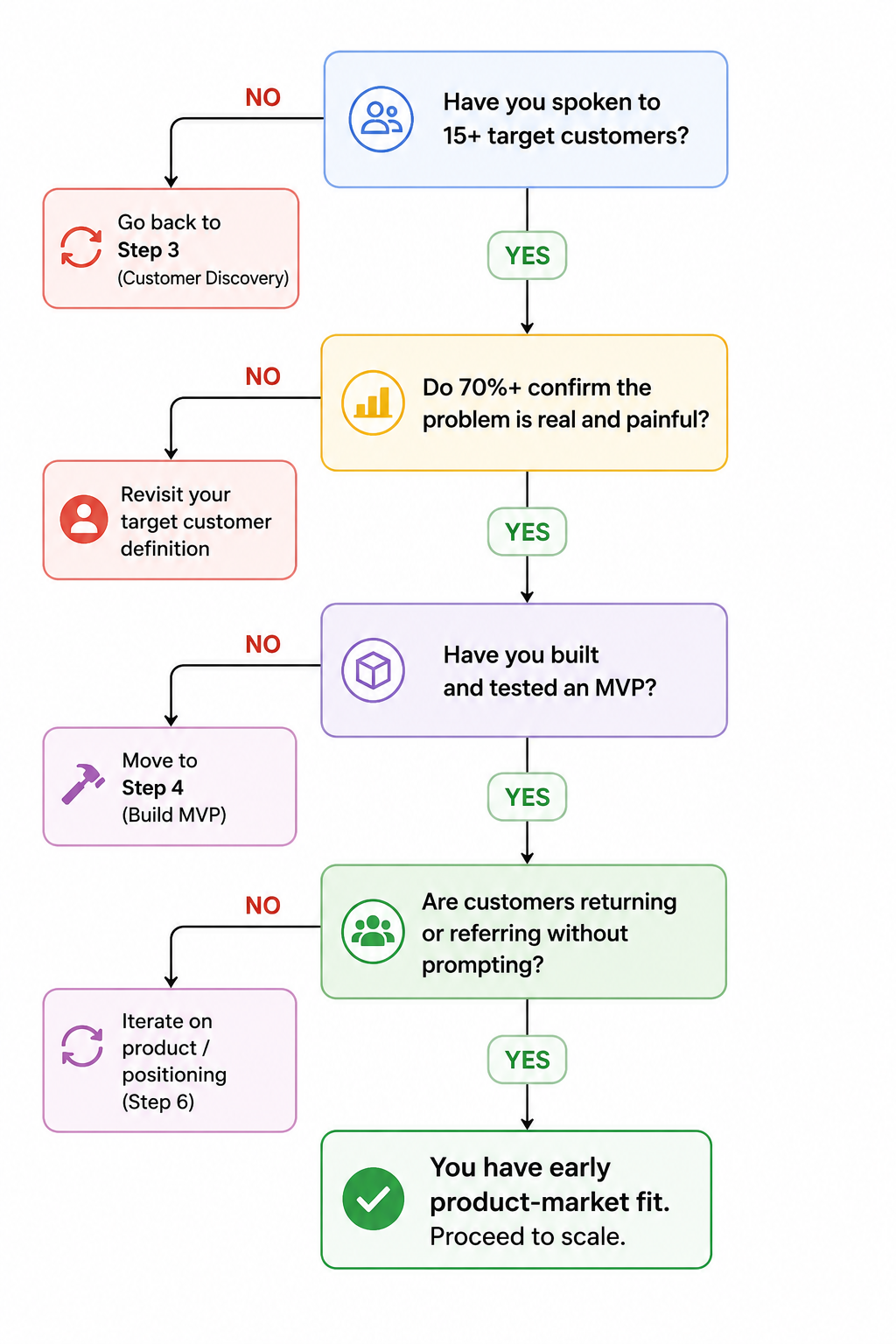
Now that you have completed the customer validation process, it is time to finalize the validation phase. This phase involves analyzing the feedback and data collected during the validation process to determine the viability of your product or service.
Here's a decision tree you should follow:
Customer validation can help you build a product people actually want. But many founders make mistakes that lead to bad decisions. Here are some common ones to avoid:
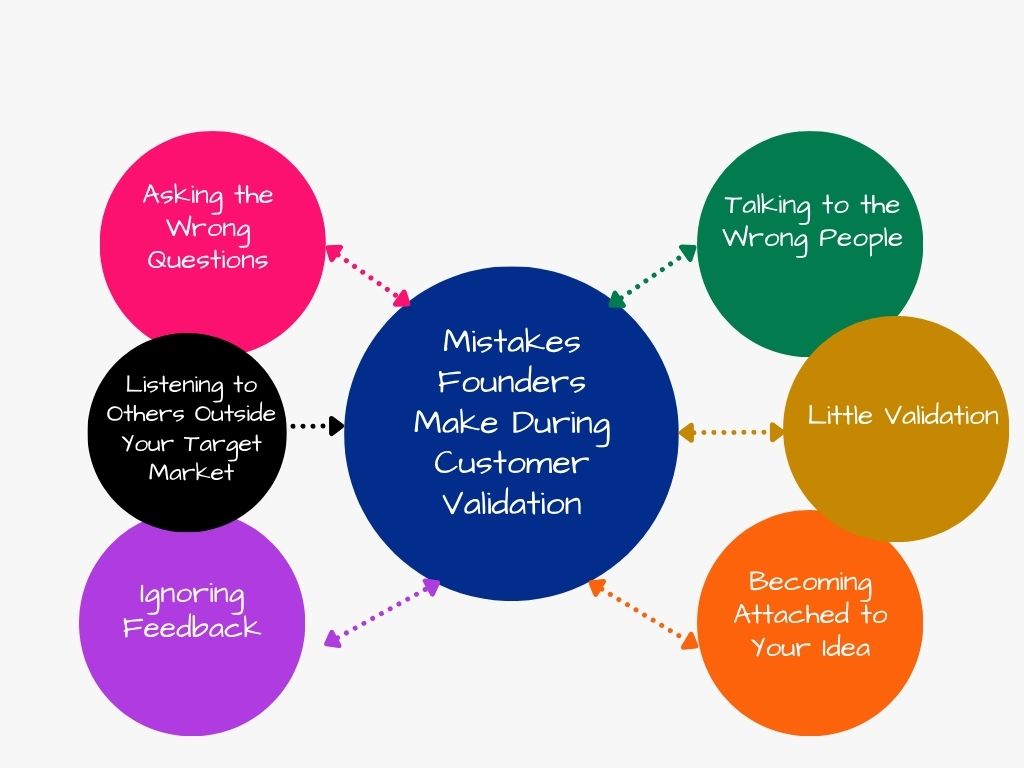
One of the biggest mistakes is assuming you already know who your customers are.
For example, you may think your product is for young professionals, but the people who need it most could be small business owners or parents. During customer validation, talk to different types of people before narrowing your focus.
Speaking to only a few people can give you a false picture of the market. If three people love your idea, that doesn't mean everyone will. The more conversations you have, the more reliable your feedback becomes.
Many founders become so attached to their product idea that they ignore feedback that challenges it.
Remember, you are not your customer. Customer validation is about learning what customers need, not proving that your idea is right.
The way you ask questions matters.
Instead of asking:
"Wouldn't this feature make your life easier?"
Ask:
"How do you currently solve this problem?"
Open-ended and neutral questions help people give honest answers. Leading questions often produce feedback you want to hear rather than feedback you need to hear.
Friends, family, and coworkers may support your idea, but their opinions don't matter much if they aren't potential customers. If you're building for marketers, talk to marketers. If you're building for startup founders, talk to startup founders. Focus on feedback from the people who would actually use and pay for your product.
Some founders spend weeks interviewing customers and then ignore what they learn.
If multiple people say they wouldn't pay for your product, find it confusing, or don't see the value, take that feedback seriously. You don't have to act on every suggestion, but you should look for recurring patterns and use them to improve your product.
Turns out finalizing the validation process is necessary to determine the viability of your product or service. By analyzing the feedback and data collected during the validation process, you can make informed decisions about your product or service and increase your chances of success in the market.
Are you ready? Collect customer validation feedback using Productlogz ,and you will be glad you did.
What is customer validation?
Customer validation is the process of confirming that your product solves a genuine problem people will pay to fix.
How is customer validation different from market validation?
Market validation determines whether a market exists for a category of product. Customer validation determines whether your specific product resonates with your specific customer. You need both, but customer validation is more actionable at the early stage.
How many customer interviews should I do before validating?
Most validation experts recommend a minimum of 15–20 interviews before drawing conclusions.
What questions should I ask during customer validation interviews?
Focus on past behavior, not future intent. Ask things like: "How do you currently handle X?" and "What have you already tried?" Avoid leading questions. Use the interview template included in this guide.
What is a Minimum Viable Product (MVP)?
An MVP is the smallest, most focused version of your product that lets you test your core assumption.
How do I know if I've achieved product-market fit?
common benchmark is the Sean Ellis test. If 40% or more of your users say they'd be very disappointed if your product went away, you have an early product-market fit.
What are the most common customer validation mistakes?
Validating with friends who won't give honest feedback, asking hypothetical questions instead of behavior-based ones, and validating too quickly with too few interviews.
What tools can I use to collect customer validation feedback?
In-app surveys, interview scheduling tools, feedback management platforms like Productlogz, and simple email outreach all work well.
No sales calls. No long setup. Create your workspace and start collecting feedback today.
