Most AI roadmap tools are just Kanban boards with chatbot features added on top.
Real AI roadmap tools help teams analyze feedback, detect trends, and prioritize features faster.
AI can reduce manual roadmap work and help SaaS teams make better product decisions.
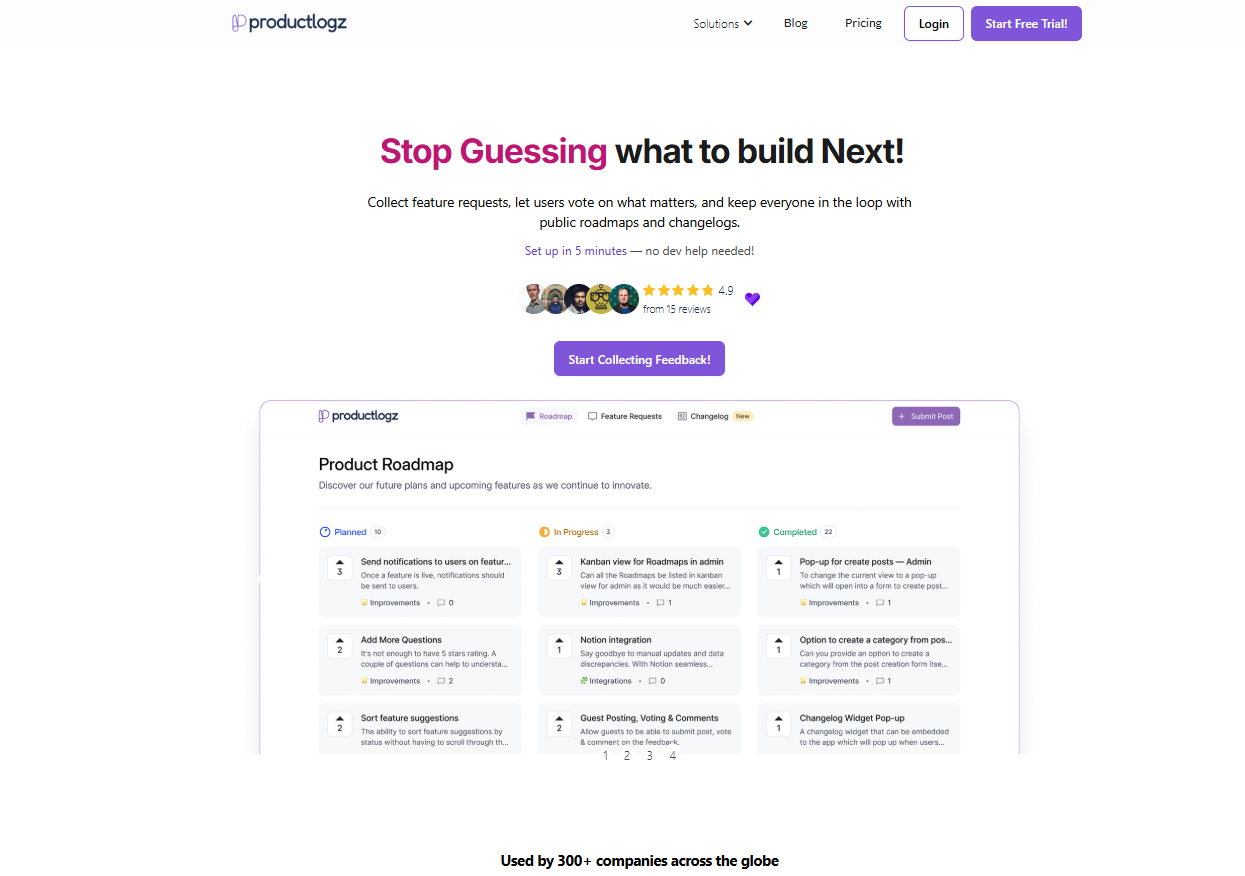
Productlogz stands out by combining AI feedback analysis, smart prioritization, public roadmaps, and changelogs in one platform.
The best roadmap tools help teams stay aligned, close the feedback loop, and build what customers actually want.
As SaaS products grow faster and customer expectations increase, manual roadmap management becomes harder to scale. In this guide, we tested the best AI product roadmap tools for SaaS teams in 2026.
What Is an AI Product Roadmap Tool?
An AI product roadmap tool is a software that helps product teams plan, prioritize, and communicate what they're building. The AI part means the tool can analyze customer feedback at scale, detect patterns in usage data, and auto-score feature requests using frameworks like RICE or ICE. They also generate roadmap summaries for different stakeholders.
Now, the best AI product roadmap tools connect customer needs directly to roadmap items. They also give product teams a single place to align around what to build next and why.
Why SaaS Teams Need AI in Their Roadmap Tools
Here's what changes when you add AI capabilities to your roadmap process:
Stop guessing what to build
AI can analyze survey responses, support tickets, and usage data to surface what users need, not just what the loudest customer is asking for.
Prioritize faster
Instead of manually scoring every feature request, AI models will do the heavy lifting and flag the items with the highest potential impact.
Aligns stakeholders without endless meetings
AI-generated roadmap summaries adapt to different audiences, whether that's your engineering team, your board, or your customers.
Closes the feedback loop automatically
When a feature ships, AI-powered tools can notify everyone who voted for it, update the changelog, and move it off the roadmap, all in real time.
How We Chose These Tools
Not every tool out there had a spot on this list. We evaluated each tool based on:
Actual AI capabilities (not just marketing language)
Integrations with tools like Jira, Linear, Slack, and GitHub
Pricing at different team sizes
Real user reviews and Reddit sentiment
Quick Glance at the Best AI Product Roadmap Tools
With eleven tools to evaluate, a quick reference saves a lot of scrolling. Use this table to narrow down your shortlist before the full breakdowns below.
Tool
Best For
AI Features
Public Roadmap
Starting Price
G2 Rating
Productlogz
Feedback-to-roadmap workflow
AI feedback analysis, smart prioritization
✅
$17/mo
Rising tool
ProductLift
All-in-one SaaS
RICE/ICE scoring, auto-notify voters
✅
$19/mo
5.0/5
Productboard
Mid-to-large SaaS
Feedback clustering, trend detection
✅
$19/mo
4.3/5
Canny
Public roadmap + voting
Autopilot, duplicate detection
✅
$19/mo
4.6/5
Aha!
Enterprise SaaS
Strategy mapping, scoring models
✅
$59/user/mo
4.3/5
Jira Product Discovery
Jira-native teams
Built-in AI from Atlassian Intelligence
❌
$10/user/mo
4.3/5
Linear
Dev-led SaaS startups
Auto-triage, timeline predictions
❌
$10/user/mo
4.6/5
Gleap
Support + roadmap in one
AI agent Kai, feedback tagging
✅
$39/mo
4.6/5
Featurebase
Early-stage startups
Duplicate detection, NPS integration
✅
$29/mo
4.9/5
Frill
Budget-friendly teams
Basic AI sorting
✅
$25/mo flat
4.7/5
Notion
DIY roadmaps
Notion AI for summarization
✅ (manual)
$10/user/mo
4.7/5
11 Best AI Product Roadmap Tools for SaaS in 2026
Below are 11 top AI roadmap tools that SaaS teams can explore:
1. Productlogz - Best Overall AI Roadmap Tool for SaaS Teams
Productlogz has quickly earned its place at the top of this list by doing something most competitors haven't done. It makes the entire journey from raw customer feedback to a shipped feature feel seamless and intelligent. Productlogz is built for SaaS teams that want AI to do the work, not just add a badge to the pricing page.
The platform also combines feedback collection, AI-powered surveys, roadmap planning, and changelog publishing in one tightly integrated workflow. Hence, product managers spend less time triaging and more time deciding.
Key Features
AI-powered survey and feedback analysis that automatically groups and summarizes customer requests
Smart prioritization engine that scores features based on frequency, revenue impact, and strategic fit
Public roadmap with custom branding and customer voting
Automatic voter notifications when feature status changes
Changelog tied directly to roadmap items for seamless release communication
Integrations with Jira, Slack, and popular CRMs
Multi-workspace support for teams managing multiple products
Clean, intuitive UI designed for both product managers and end users
Pros
AI is genuinely embedded in the workflow, not just a surface-level feature
Smart prioritization saves meaningful time for lean product teams
Feedback-to-roadmap connection is direct, reducing manual handoffs
A modern interface that customers find easy and enjoyable to use
Transparent, predictable pricing without per-user traps
Cons
Newer platform with a smaller community
Enterprise-tier integrations are still expanding
Less suitable for very large organizations with complex portfolio needs
Pricing
Plan
Price
What’s Included
Pro plan
$17/mo
Unlimited Feedback & Roadmap items
Business plan
$53/mo
Everything in Pro plan, plus other features like Advanced reporting
A free plan is also available
Best for: SaaS teams of any size that want AI integrated into their feedback and roadmap workflow, with a great experience for both the product team and their customers.
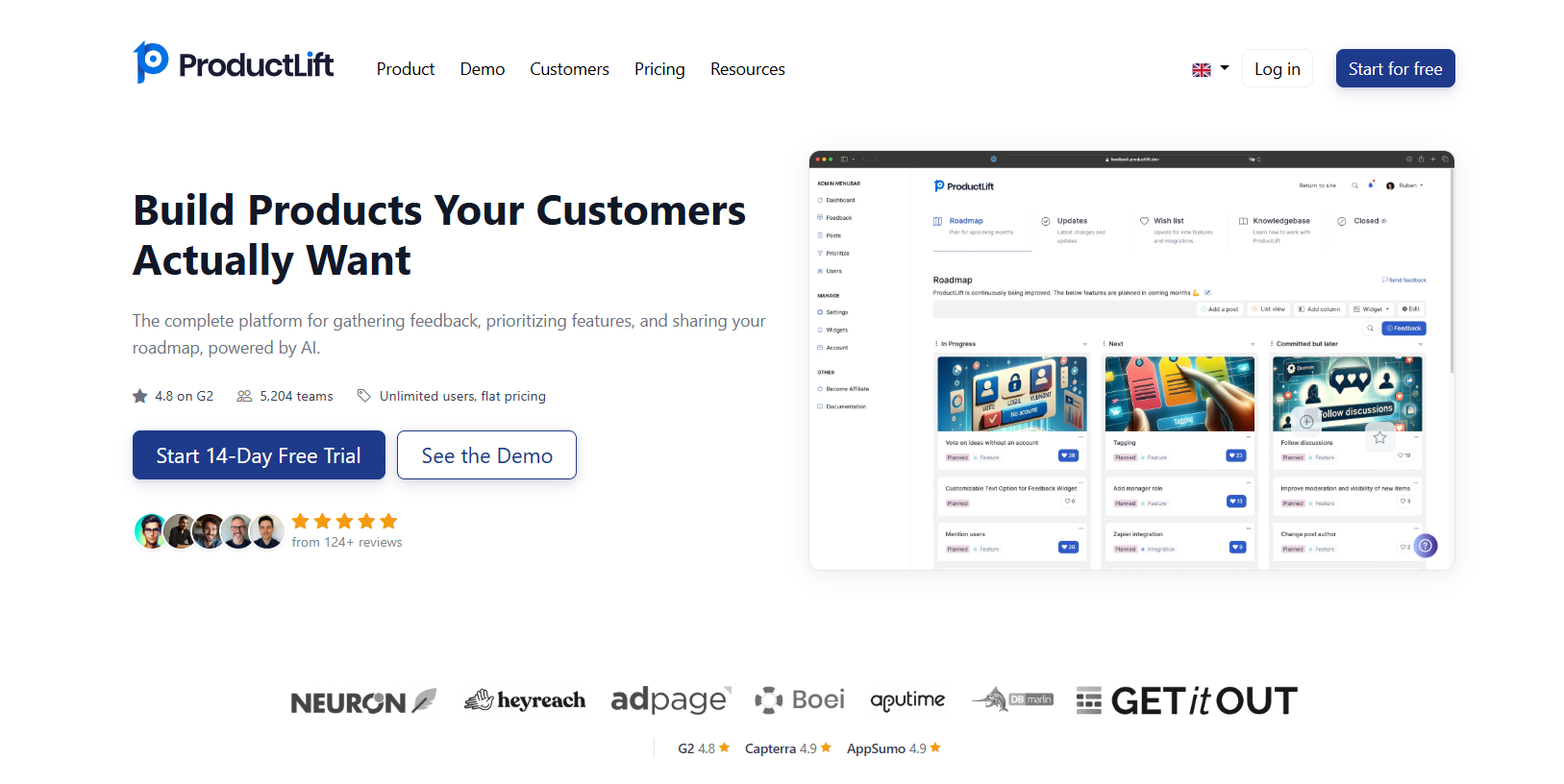
2. ProductLift - All-in-One AI Roadmap for SaaS Teams
ProductLift is built specifically for SaaS teams who ship weekly and need more than just a pretty roadmap board. It combines feedback collection, roadmap planning, changelog, and a knowledge base in one platform. Also, the AI is actually woven into the workflow, not bolted on.
14-day free trial available. No credit card required.
Best for: SaaS teams of 5 to 50 people who want a complete feedback-to-roadmap workflow without stitching together multiple tools.
3. Productboard - Best for AI-Powered Customer Insights
Productboard has been the go-to product management platform for years. In 2026, it added AI capabilities that make prioritization significantly faster. It can analyze feedback, detect trends across thousands of data points, and suggest what to build next based on patterns most PMs would miss.
What makes it powerful is the workflow. AI makes the prioritization faster by surfacing insights, but the tool itself gives you the structure to act on them.
Key Features
AI feedback clustering and trend detection across large data sets
Customer insights portal that pulls data from Jira, Salesforce, and Zendesk
Advanced feature scoring with custom prioritization formulas
Public-facing roadmap portal with white-label branding
Product hierarchy for managing multiple product lines
No-code custom prioritization frameworks
Pros
The AI surfaces patterns in large feedback volumes that humans would miss
Best tool for connecting roadmap decisions to strategic business goals
Handles complex multi-product organizations well
Strong stakeholder alignment features
Trusted by hundreds of enterprise product teams
Cons
Expensive
No built-in changelog, you'll need a separate tool
Customers must create an account to vote, which reduces participation
Pricing
Plan
Price
Notes
Essentials
$19/maker/mo
Basic features, no AI or objectives
Pro
$59/maker/mo
Full AI features, OKR linking
Enterprise
Custom
Advanced security, SSO
Best for: SaaS companies at $1M+ ARR with product teams who need advanced customer research workflows.
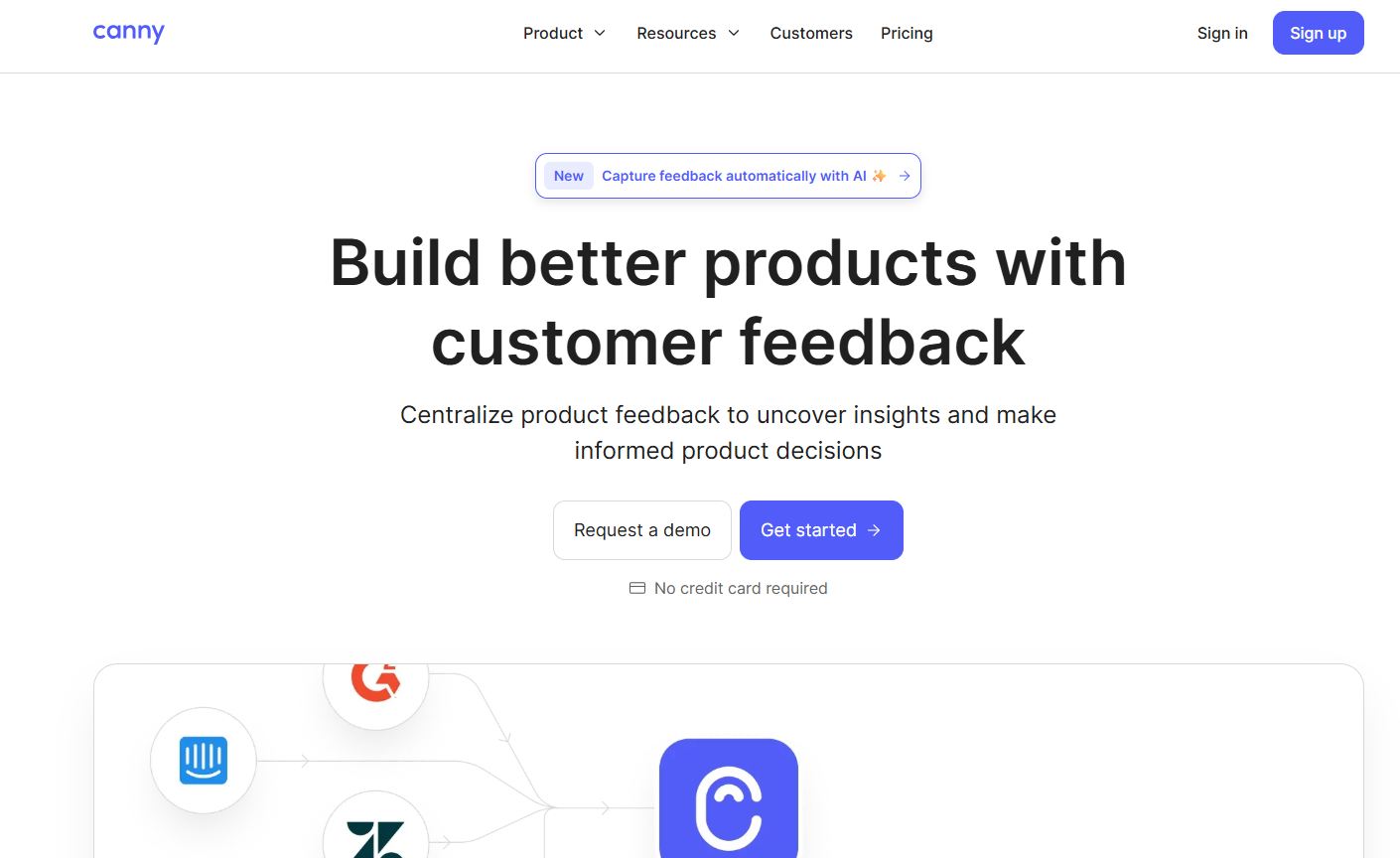
4. Canny - Best Public Roadmap with AI Voting Features
Canny is one of the most established dedicated roadmap and feature voting tools in the market. It's been around since 2016 and has an experience that both admins and customers find easy to use.
The AI angle here is Canny Autopilot, which uses machine learning to automatically detect and merge duplicate feature requests. If you have a high-volume feedback board, this alone saves hours of manual cleanup every week.
Key Features
AI categorization of incoming feature requests
Public roadmap with status columns (Planned, In Progress, Complete)
Best-in-class GitHub integration for dev-led teams
Intercom and Zendesk integrations to collect feedback from support tickets
Drag-and-drop status board with simple workflow
Pros
Modern UI that customers genuinely enjoy using
GitHub integration is the best in the category
Free plan available for up to 25 tracked users
Quick setup
AI duplicate detection saves meaningful time at scale
Cons
Tracked user pricing scales painfully as your SaaS grows
English-only, no localization support
No knowledge base, you'll need a separate tool
Pricing
Plan
Price
Notes
Core
$19/mo
Limited tracked users (annual billing)
Pro
$79/mo
More tracked users, advanced features
Business
Custom
Enterprise pricing
Best for: Early-stage SaaS teams with fewer than 25 tracked users, or GitHub-centric teams serving English-speaking markets.
5. Aha! - Best for Enterprise SaaS Strategy and Roadmap Planning
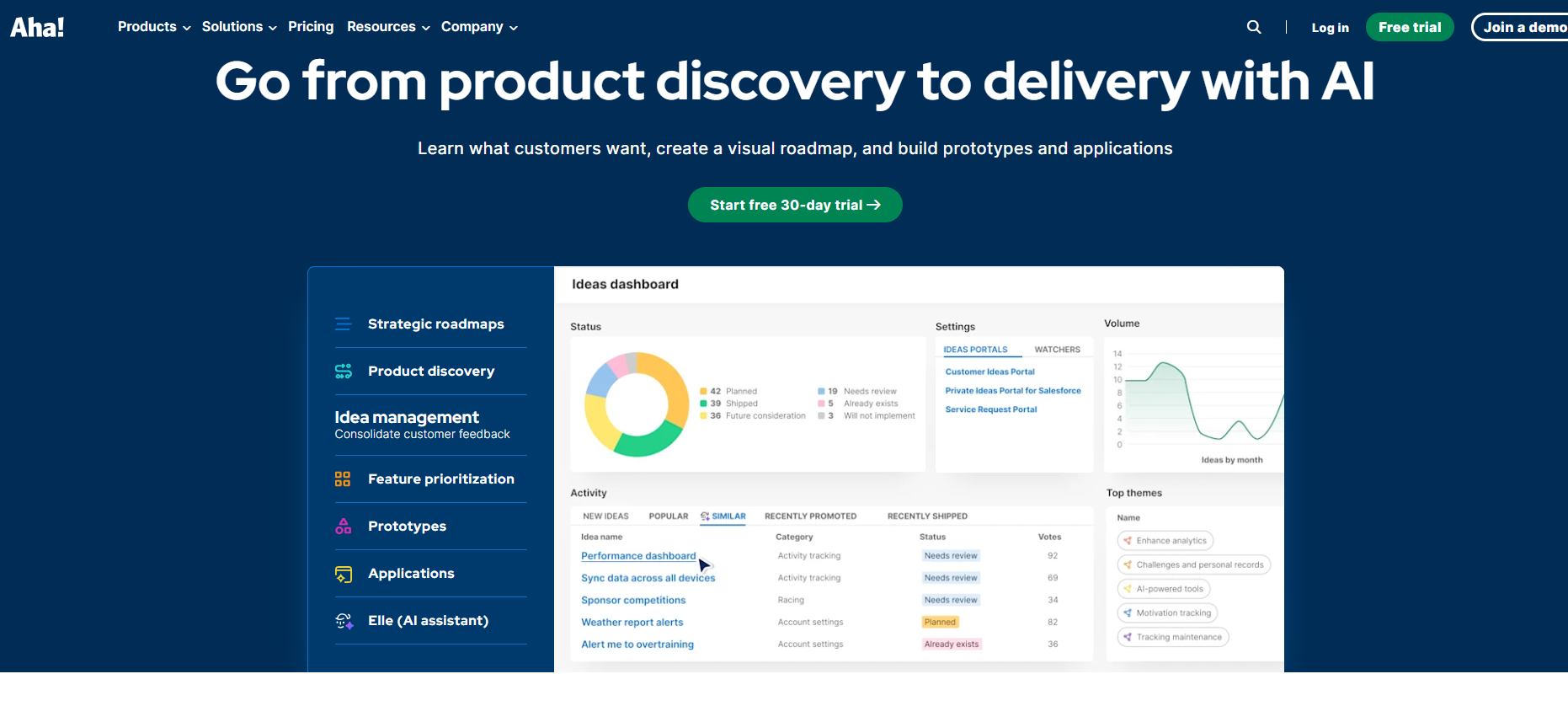
Aha! is the most comprehensive product suite on this list. It goes beyond roadmap planning and covers the full product lifecycle: strategy, OKRs, idea management, sprint planning, release management, and more.
The AI capabilities in Aha! are built into the strategic layer. You can use predictive models to score features, build custom prioritization formulas, and connect roadmap items to company goals.
Key Features
AI-assisted feature scoring and impact vs. effort analysis
Complete strategy mapping with vision, goals, and initiatives
Portfolio roadmap views across multiple product lines
Gantt charts, timeline views, and board views
Capacity planning and sprint management
Advanced reporting for board-level presentations
Pros
Excellent for aligning roadmap decisions with strategic business goals
Best visual roadmap presentation tools for executive and board reporting
Strong multi-product portfolio management
Handles complex dependency mapping and release planning
Cons
Starts at $59/user/mo, which makes it expensive
Overkill for teams under 20 people
No built-in customer support or live chat
Pricing
Plan
Price
Notes
Discovery
$39/user/mo
Basic roadmapping
Roadmaps
$59/user/mo
Includes Ideas Essentials and Whiteboards
Enterprise
Custom
Advanced security, SSO, dedicated support
Best for: Enterprise SaaS companies at $10M+ ARR with multiple product lines and large product teams who need strategic alignment tools.
6. Jira Product Discovery - Best for Jira-Native SaaS Teams
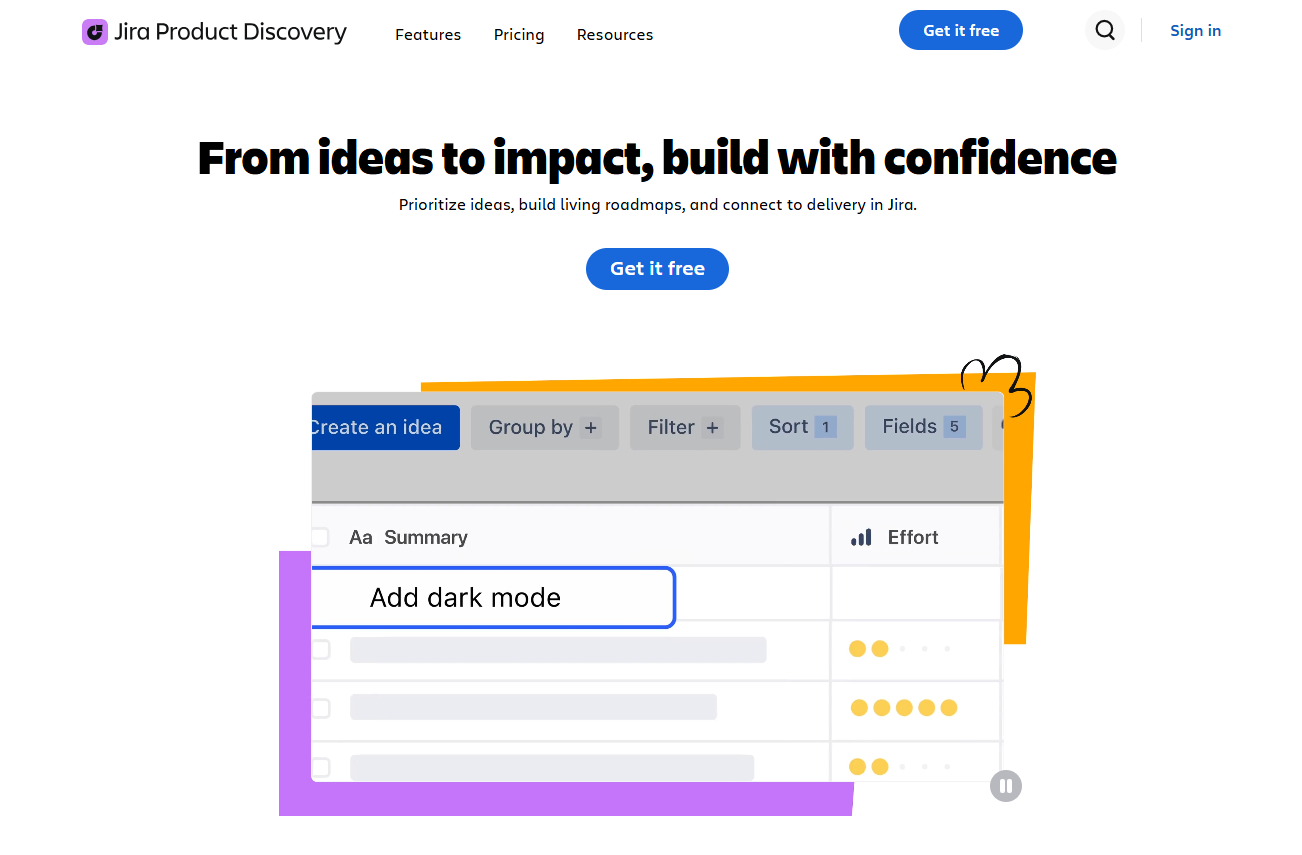
If your engineering team lives in Jira, Jira Product Discovery (JPD) is the most logical home for your product roadmap. Ideas sync directly to Jira issues, so there's no manual handoff between what PMs plan and what engineers build.
Key Features
Native integration with Jira Software (ideas sync directly to issues and epics)
Atlassian Intelligence for feedback clustering and smart suggestions
Custom prioritization fields and scoring criteria
19-language support
Confluence integration for roadmap documentation
Custom views and filters for different stakeholder groups
Pros
If you already use Jira, this is the most affordable option at $8.15/user/mo
Seamless handoff between product planning and engineering execution
Part of the broader Atlassian ecosystem (Confluence, Trello, etc.)
Good multilingual support for international teams
No extra learning curve if you already know Jira
Cons
Customers cannot see or vote on your roadmap
Not ideal for customer-facing transparency
Requires a Jira subscription to get the full value
Pricing
Plan
Price
Notes
Standard
$10/user/mo
With Jira, billed annually
Premium
$25/user/mo
Advanced features
Best for: SaaS engineering teams already using Jira who need an internal roadmap tool but do not need customer-facing transparency.
7. Linear - Best for Fast-Moving SaaS Startups
Linear is not a traditional roadmap tool. It's a product development platform built for engineering-led teams who ship fast. But for SaaS startups where the line between roadmap and execution is thin, it works incredibly well.
For Linear, the roadmap view is intentionally simple: Backlog, In Progress, Done. The AI handles auto-triage, timeline predictions, and smart labeling so your team spends less time managing the tool and more time building.
Key Features
Auto-triage for issues and feature requests
Predictive timeline estimates based on historical velocity
Smart labeling and automatic issue assignment
Beautiful, fast UI with keyboard-first navigation
GitHub and GitLab integration for connecting commits to roadmap items
Pros
Extremely fast UI that engineers actually enjoy using
AI timeline predictions help with sprint planning
The free plan is usable with unlimited users
Real-time collaboration without the bloat
Cons
Not built for stakeholder presentations or executive reporting
Limited prioritization frameworks
Poor fit for teams that need external transparency
Pricing
Plan
Price
Notes
Basic
$10/user/mo
Advanced features, analytics
Business
$16/user/mo
Guest access, advanced admin
Best for: Engineering-led SaaS startups where the roadmap is primarily an internal dev planning tool and the team ships multiple times a week.
8. Gleap - Best for Combining Customer Support and Roadmap in One Platform
Gleap is the only tool on this list that bundles a public roadmap and feature voting with a full customer support platform. This includes live chat, an AI support agent, bug reporting, in-app surveys, and email. For SaaS founders currently paying for both Canny and Intercom (or similar), Gleap often cuts that cost significantly.
Key Features
AI agent Kai for auto-tagging, categorizing, and routing customer feedback
Feature requests and support tickets in a unified shared inbox
Public roadmap with embedded support (inside your app or on a custom domain)
Live chat, email, and WhatsApp support channels included
Pros
Replaces multiple tools
Mobile-native support is rare in this category
Strong cost efficiency for teams currently running separate support and roadmap stacks
Automatic voter notifications close the feedback loop without manual work
Cons
Higher starting price than standalone roadmap tools
Newer in the market, less proven at a very large scale
Pricing
Plan
Price
Notes
Hobby
$39/mo
1 team member + 1 project
Team
$149/mo
Full platform: chat, AI, roadmap, feedback, surveys
Enterprise
Custom
Advanced security, SSO, dedicated support
Best for: SaaS teams of 3 to 100 people currently running separate support and roadmap tools who want to save money.
9. Featurebase - Best Free AI Roadmap Tool for Early-Stage SaaS
Featurebase has become one of the best alternatives to Canny for early-stage SaaS teams. It offers a feedback board, public roadmap, changelog, and basic NPS and CSAT surveys on a free plan with useful limits.
The AI features include duplicate detection and basic trend identification in feature requests. It's not as deep as Productboard's AI. However, for a team under $100K ARR that needs a working system today, Featurebase delivers surprising value at zero cost.
Key Features
Automated duplicate detection for feature requests
Public roadmap with customer voting
Changelog for announcing shipped features
Custom domain support on paid plans
Jira and Linear integrations
SSO on paid plans
Pros
NPS/CSAT integration is a differentiator at this price
Modern interface that customers enjoy interacting with
Flat pricing on paid plans with no per-user trap
Quick setup with minimal configuration needed
Cons
Limited integrations on the free plan
AI features are basic compared to enterprise options
Pricing
Plan
Price
Notes
Growth
$29/mo
Custom domain, SSO, advanced integrations
Professional
$59/mo
Advanced analytics, white-labeling
Best for: Pre-revenue or early-stage SaaS teams that need a public roadmap and feedback board
10. Frill - Best Budget-Friendly Roadmap + Feedback Tool
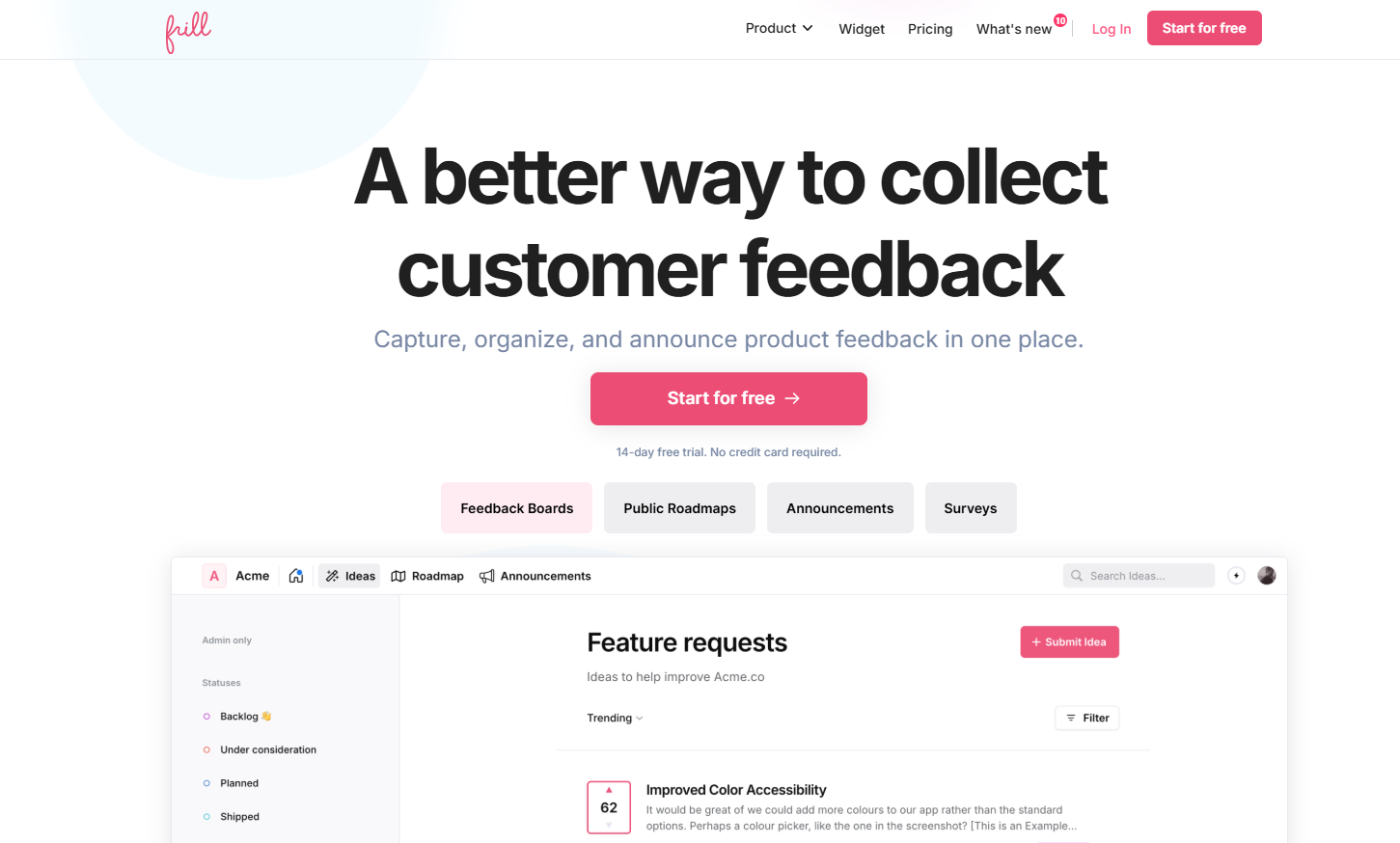
Frill is a roadmap tool that does three things well. It collects feedback, shows a public roadmap, and announces what shipped.
The AI features are simple sorting and categorization of ideas. But the value is in the flat pricing. You pay $25 per month regardless of how many users or voters you have.
Key Features
Feedback board with customer voting
Public roadmap with status columns
Changelog for release announcements
Jira and GitHub integrations
Zapier integration for custom workflows
Pros
Flat $25/mo pricing with no per-user surprises
Extremely simple to set up and maintain
Good Jira and GitHub integrations for a tool at this price
Cons
English-only, no multilingual support
No prioritization frameworks (RICE, ICE, etc.)
You will likely outgrow it as your product scales
Pricing
Plan
Price
Notes
Startup
$25/mo
All core features, flat rate
Business
$49/mo
White-label, custom domain
Enterprise
Custom
Advanced features
Best for: Small SaaS teams (1 to 5 people) that need an affordable roadmap tool.
11. Notion - Best DIY AI Roadmap for Pre-Revenue SaaS
Notion is not a roadmap tool. However, thousands of SaaS founders use it as one. With Notion AI added to the mix, it becomes a powerful workspace for teams that want full customization and don't mind setting things up manually.
Notion AI helps product managers summarize customer feedback, draft feature specs, and generate roadmap updates for different stakeholders. It won't auto-notify voters or score features automatically. But for a pre-revenue founder who needs zero cost, it's hard to argue against starting here.
Key Features
Database-driven roadmap templates
Flexible page structure for combining roadmap with docs, research, and meeting notes
Public page publishing at a custom domain
Integrations with Slack, GitHub, Jira, and hundreds of tools via Zapier
AI writing assistance for PRDs and stakeholder updates
Pros
Free plan covers most needs for a pre-revenue founder
Fully customizable to fit any workflow or team style
Huge template library to get started quickly
Cons
No automatic notifications when features ship
You will outgrow it quickly once you have users submitting feedback
Pricing
Plan
Price
Notes
Plus
$10/user/mo
Teams and guests
Business
$20/user/mo
Advanced permissions, SAML SSO
Best for: Pre-revenue founders or solo product managers who want $0 infrastructure and are comfortable building their own system from scratch.
Best Practices for Using AI in Your Roadmap Process
Having the right tool is only half the equation. The teams that get the most out of AI-powered roadmap tools are the ones that build the right habits around how they feed and use the system. They are:
Feed the AI good data: AI is only as good as the product data you give it. Structured data produces far better insights than a pile of raw messages.
Use AI to prioritize, not to decide: AI highlights patterns and surface insights. But roadmap decisions should still reflect your product vision and business goals.
Connect your roadmap to customer feedback: The most effective roadmap reflects actual customer needs. Use tools that link feedback directly to roadmap items and show you how many users want each feature.
Set up automatic notifications: When a feature ships, every user who voted for it should hear about it automatically. This closes the loop, builds trust, and reduces churn.
Keep your roadmap updated in real time: A stale roadmap is worse than no roadmap. Pick tools that make updating a 10-second action, not a planning session.
Align roadmap items to business goals: Every item on your roadmap should connect to a specific outcome. Tools like Aha! and Productlogz make this explicit.
Final Thoughts
The best AI product roadmap tools help SaaS teams move faster by turning customer feedback into smarter product decisions.
While every tool on this list has strengths, Productlogz stands out as the best choice for most SaaS teams. It combines AI-powered survey and feedback analysis, public roadmaps, changelogs, and a good user experience at an affordable price.
So, if you want a roadmap tool that saves time and improves product planning, try Productlogz for free and see the difference for yourself.
Frequently Asked Questions
What is an AI product roadmap tool?
An AI product roadmap tool is a software that helps product teams plan, prioritize, and communicate product features using artificial intelligence.
Do I need a public roadmap for my SaaS product?
Yes, in most cases. Public roadmaps build trust with customers, reduce support tickets, and let users vote on what matters most to them.
What is the difference between a product roadmap tool and project management software?
Product roadmap tools are strategic and customer-facing. They show what you're going to build and why. Project management software is tactical and internal. It tracks who is doing what tasks.
How do AI agents help with product roadmaps?
AI agents in roadmap tools handle automated tasks like updating roadmap statuses, notifying voters when features ship, and generating changelog entries.
What is the future of AI product roadmap tools?
The future is AI agents that handle the entire feedback-to-roadmap workflow automatically.
Share this post
Sifon Jimmy
May 15, 2026
•
5 min read
Simplifying Feedback Management for SaaS
Ready to get started?
No sales calls. No long setup. Create your workspace and start collecting feedback today.