


If you've ever sent out a survey and got back a handful of vague responses, you already know there's a problem. Research shows that the average human attention span is only 8 seconds. Hence, traditional surveys no longer cut it.
This is why you need to use AI in-app survey tools. The good news is that these tools keep improving every day.
In this article, we will walk you through the 10 best AI survey tools in 2026, explain what makes each one worth your attention, and help you choose the right one for your needs.
Before we go into the list of AI tools, let us quickly explain why AI and machine learning have completely changed the survey game.
Old-school survey design software made you do everything manually. This includes writing every survey question and then spending hours trying to make sense of your survey data.
AI survey tools flip that entirely. Today's best platforms let you:
And the best part? You don't need to be a data scientist to use any of these. They're built for real teams. This includes product managers, marketers, customer experience leads, researchers, and anyone who needs better insights without all the manual work.
Now, let's get into the actual tools.
The table below shows a brief comparison between our list of the best AI survey tools:
Now, let us look at each of these AI survey tools. As you read through, you should be able to figure out which of them suits your business and how you can make high-quality surveys:

If you want one tool that does it all and does it well, then Productlogz is what you need. It is built specifically for product teams and SaaS businesses that need to collect feedback directly inside their web and mobile apps.
Pros:
Cons:
Best for: Product teams, SaaS companies, in-app feedback programs
Free plan: Available
Free trial: Yes
Paid plans from: $17/month

Zonka Feedback is a comprehensive survey platform that has been significantly enhancing its AI features. It's a great choice if you need to collect feedback across multiple touchpoints, not just inside your app, but also via email, kiosks, QR codes, and more.
The AI capabilities here are genuinely impressive. You get AI-driven sentiment analysis, emotion detection, and intent tagging for open-ended responses. Instead of manually reviewing every survey response, the tool flags what's positive, what's negative, and what needs action.
Pros:
Cons:
Best for: CX teams, multi-channel feedback programs
Free plan: Yes
Free trial: 14 days
Paid plans from: $49/month

SurveyMonkey is one of the most recognized names in the survey space, and it remains a major platform in 2026, especially for market research.
What makes SurveyMonkey unique is the ability actually to purchase survey responses. If you don't have an existing audience to survey, you can buy a guaranteed number of responses from a targeted panel. That's a huge time-saver for researchers and marketers.
Pros:
Cons:
Best for: Market research, buying survey responses, mobile-friendly survey creation
Free plan: Yes (10 questions, 25 responses)
Paid plans from: $25/month

If you're after surveys that feel engaging and conversational, Typeform is hard to beat. It's one of the most beginner-friendly survey apps, yet powerful enough for experienced survey builders.
Typeform's visual logic branching is a standout feature. As you add conditional logic to your survey, it automatically generates a flowchart that shows how users will progress through each question.
Pros:
Cons:
Best for: Beginners, visually engaging surveys, website embeds
Free plan: Yes (up to 10 responses/month)
Paid plans from: $29/month
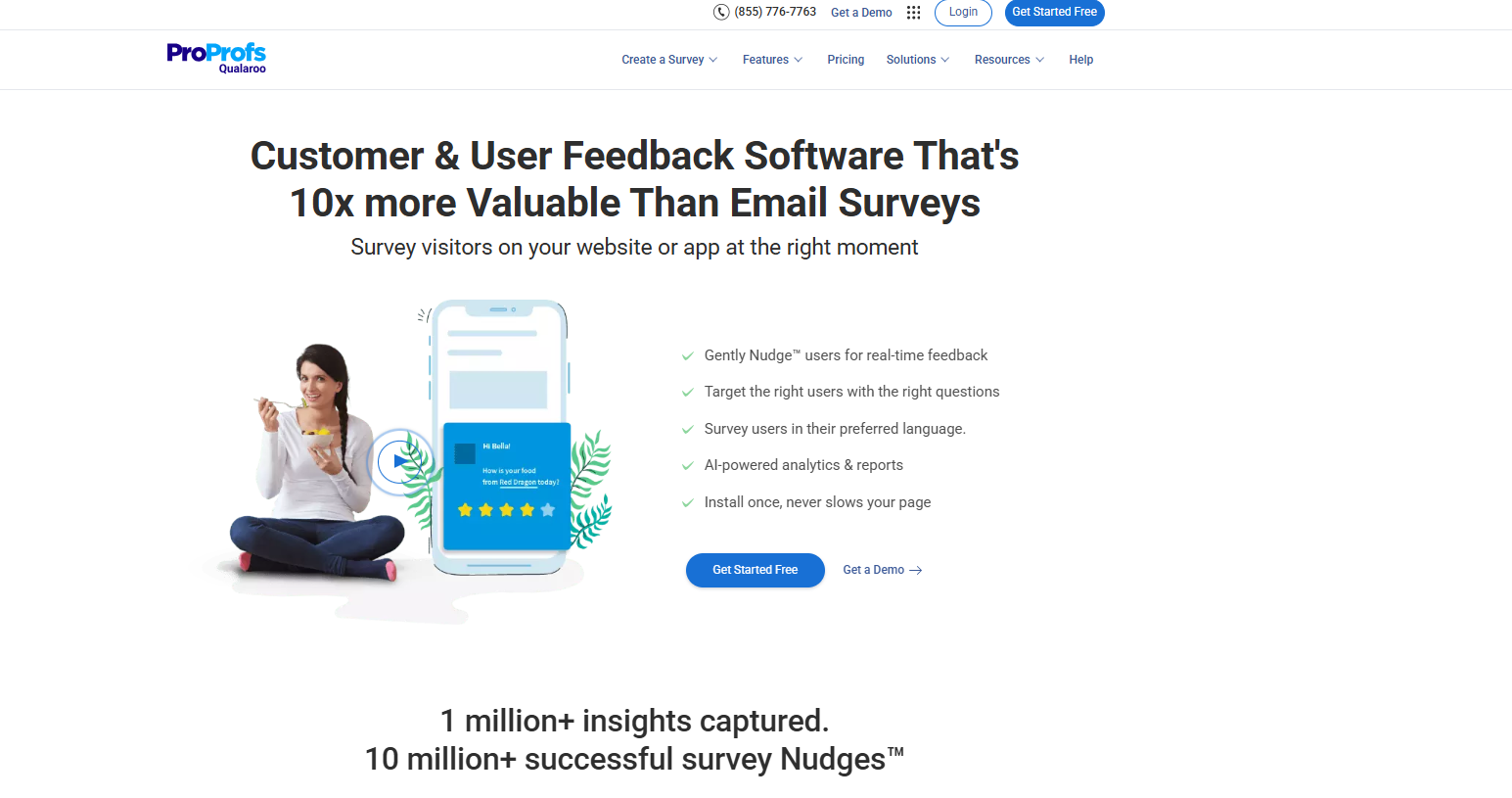
Qualaroo is a solid choice if you want to run targeted surveys that appear at the right moment to the right users. Their "Nudge" survey format is designed to be small, non-intrusive, and highly contextual. This way, surveys feel natural rather than disruptive.
Pros:
Cons:
Best for: Contextual in-app surveys, website feedback, UX research
Free plan: Yes
Paid plans from: $19.99/month

Refiner helps SaaS companies build surveys. If your entire business runs on a web app or software product, Refiner is designed specifically for you.
The platform makes it easy to run in-app surveys throughout the customer lifecycle, from onboarding through retention and churn. You can trigger surveys based on events, user attributes, and lifecycle stages.
Pros:
Cons:
Best for: SaaS teams, lifecycle feedback programs
Free trial: Yes
Paid plans from: $99/month

If data privacy is a top priority for your team, Formbricks is the survey tool for you. It's open-source, self-hosted, and built with GDPR and CCPA compliance built in.
You get full control over your survey data. No one else has access unless you choose to share it. That makes Formbricks particularly attractive for companies in regulated industries or those building products in regions with strict data laws.
Pros:
Cons:
Best for: Privacy-focused teams, open-source enthusiasts, regulated industries
Free plan: Yes
Cloud plan from: $49/month

Userpilot is an all-in-one product experience platform, and its in-app survey capabilities are a key part of what it offers. What makes it especially appealing is that it is one of the tools that allows no-code survey creation. With this, you can build, customize, and launch in-app surveys without involving your engineering team.
You can also set up surveys to trigger based on specific user actions, onboarding steps, and feature usage.
Pros:
Cons:
Best for: No-code in-app surveys, product-led growth teams
Starter plan from: $299/month (billed annually)

SurveySparrow lets you create surveys that feel like a chat conversation instead of a traditional form. If you've ever found that surveys feel cold or formal to your users, SurveySparrow's chatbot format is worth trying.
The conversational format has been shown to improve engagement and completion rates. This is because people are simply more comfortable with chat than with long lists of questions.
Pros:
Cons:
Best for: Chatbot-style surveys, improving completion rates
Free plan: Yes (3 surveys, 75 responses/quarter)
Paid plans from: $19/month

Survicate rounds out this list with a genuinely impressive offering. Its survey tools offer AI-powered conversational analytics that work across all your feedback sources at once. The idea is to connect all your feedback channels (in-app surveys, chat, CRM, support tools), then ask the AI questions such as "What are users complaining about most this month?" and receive actionable answers derived from your combined data.
Pros:
Cons:
Best for: Conversational analytics, multi-source feedback analysis
Free plan: Yes (1 active survey, 25 responses/month)
Paid plans from: $79/month
With so many survey platforms available, it's easy to get overwhelmed. Here are a few simple questions to help guide your decision.
Some tools specialize in in-app feedback, while others focus more on email or link-based surveys. If your goal is to collect feedback within your product while users are actively using it, tools such as Productlogz, Refiner, Qualaroo, or Userpilot will be a better fit.
However, if you primarily want to run market research surveys or send questionnaires to external audiences, platforms such as SurveyMonkey or Typeform may be better suited.
Almost every modern survey tool now offers some level of AI assistance, but the depth varies. Basic survey AI features usually include:
For many teams, especially startups and SaaS companies, it's important to launch surveys without relying on developers. Look for tools that offer:
Productlogz is beginner-friendly in this regard.
For companies operating in regulated industries or regions with strict privacy laws, data control can be a major factor. If privacy is a priority, choose open-source platforms that let you self-host and fully control your survey data.
Pricing across survey platforms varies widely. Some tools start around $19/month, while advanced product experience platforms can exceed $300/month.
Fortunately, many tools offer free plans or trials, which makes it easy to test several options before committing.
AI survey tools make it much easier for teams to collect and understand feedback. If you're looking for a fast way to collect feedback directly inside your product, Productlogz is a great place to start.
Its AI-powered survey builder, behavioral triggers, and in-app survey capabilities make it easy to turn user feedback into actionable product insights in minutes.
The best part? You can get started for free. Hundreds of product teams are already using Productlogz to turn user feedback into their biggest competitive advantage. Sign up for Productlogz today and launch your first AI-powered in-app survey in minutes.
What is an AI survey tool?
An AI survey tool is survey software that uses artificial intelligence to help you create surveys, analyze responses, and detect sentiment in open-ended answers.
What's the difference between an in-app survey and an email survey?
Email surveys are sent after the experience, while in-app surveys appear while the user is actively using your product.
Can I use AI to build my survey?
Absolutely. Productlogz lets you use AI to generate a complete survey from a simple prompt.
What is sentiment analysis in a survey tool?
Sentiment analysis is an AI feature that automatically analyzes open-ended survey responses and classifies feedback as positive, negative, or neutral.
No sales calls. No long setup. Create your workspace and start collecting feedback today.
