

Over 80% of customer feedback never sees the light of day. This means eight out of every ten comments or feature requests pile up in silence while competitors move faster. Luckily, AI is closing that gap and changing how product managers collect and manage user feedback. In this article, we'll break down exactly how AI helps in managing user feedback and why it's become essential.
AI customer feedback analysis refers to using artificial intelligence technologies to automatically collect, process, and interpret large volumes of customer feedback from multiple sources. These technologies include natural language processing (NLP), machine learning, and generative AI.
Rather than a human reading every comment, AI tools scan thousands of responses simultaneously. They identify recurring themes, detect customer sentiments, flag unusual patterns, and surface actionable insights. They do all of these at a speed and scale no human team could match.
Before we talk about what AI can do, it helps to understand what's broken without it. Traditional feedback management relies on manual analysis of responses, tries to categorize them, and builds a report. By the time that report lands in someone's inbox, the feedback is already old news.
Rather than manually sorting through feedback, teams often end up skimming. This means subtle patterns get missed, and the loudest voices get the most attention, whether or not they represent the broader customer base.
Add that to the explosion of feedback channels like app reviews, social media comments, customer service chats, etc., and you've got a data problem that no spreadsheet can solve. According to research, 84% of consumers search online for local businesses every day. For time-sensitive industries, customers act within 48 hours of searching. That's an incredibly tight window. The stakes are real. And that's why AI in customer feedback analysis has gone from a nice-to-have to a must-have.
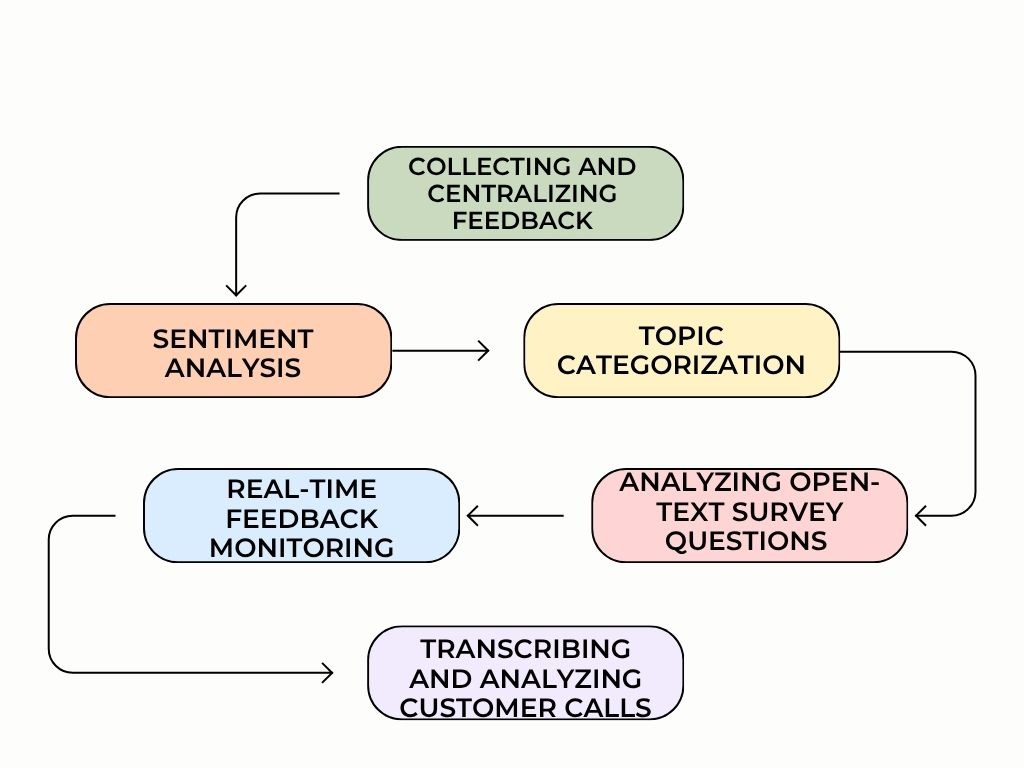
Here's how AI transforms customer feedback management:
Feedback lives everywhere. You find them in app store reviews, NPS surveys, social media, and user interviews. The problem isn't a lack of feedback. It's that it's scattered across too many places to manage effectively. However, AI-powered platforms integrate every source into one unified hub. It helps your product, marketing, and support teams all work from the same data in real time.
Sentiment analysis is arguably the most widely used application of AI in customer feedback. It means how AI reads emotion into text. Then, identify whether a piece of feedback is positive, negative, or neutral.
But modern AI-powered sentiment analysis goes well beyond a thumbs-up or thumbs-down. It can detect frustration buried in formally polite language and catch enthusiasm masked by casual phrasing. It can even understand the difference between an annoyed customer and one who's about to churn.
NLP models are trained on massive datasets and are remarkably effective at picking up nuance in a way that keyword-based tools simply can't. For product managers and customer success leaders, having a real-time view of customer sentiment means you can spot a developing problem before it becomes a crisis.
Raw feedback without structure is almost impossible to act on. AI tools categorize feedback into topics relevant to your product or business. These categories include pricing, onboarding, performance, customer support, feature requests, and so on. And unlike a human manually tagging feedback, AI doesn't get inconsistent after 300 responses
Open-ended survey questions are where the most valuable qualitative insights live. The problem is that they're also the hardest to analyze. Ask 1,000 people, "What could we do better?" and you get 1,000 unique, unstructured answers.
Fortunately, AI uses natural language processing to read every open-text response, group similar answers together, and summarize the key patterns in seconds. This means survey data that would have taken a week to analyze can now be turned into actionable insights in minutes.
And because AI treats every response with equal weight, it doesn't over-index on the most vocal respondents. You get a balanced picture of what your entire customer base is saying, not just the squeaky wheels.
One of the most powerful advantages of leveraging AI in feedback management is the ability to monitor feedback in real time. Rather than waiting for a weekly report, AI tools can alert you the moment something shifts. This shift might be a sudden increase in complaints about a specific feature, a drop in satisfaction scores after a product update, or a wave of positive feedback following a new release.
With 76% of customers expecting a response within 24 hours, the speed enabled by real-time AI analysis isn't a luxury. It's a competitive advantage.
Some of the richest feedback your business receives never gets written down. Sales call recordings, user research interviews, and customer support calls are goldmines of insight. However, they're incredibly time-consuming to analyze without AI.
AI-powered transcription tools can convert audio and video into text. Then, analyze that content the same way they analyze written feedback. In fact, the integration of AI into this part of the research workflow has transformed how fast teams can go from a user interview to a product decision.

Different roles can use AI to manage and respond to customer feedback. They include:
Product managers need a deep understanding of customer needs to prioritize effectively. AI helps them identify the most common issues among users, gather feature requests from feedback across multiple channels, and analyze customer satisfaction with specific features. Instead of waiting weeks for a research report, PMs can get data in hours and build roadmaps that are grounded in real customer expectations.
Customer success teams live and breathe customer interactions. AI empowers them to identify early churn signals in feedback data, analyze patterns in support ticket sentiment, and understand which features drive the most customer satisfaction. Also, AI agents can help managers write personalized follow-up messages at scale. This is very important for enhancing customer experience without burning out the team.
Marketers can use AI to understand what messaging resonates most with their customer base. They can analyze sentiment around campaigns in real time. Furthermore, they can uncover the language customers use to describe their problems.
AI helps managers to handle feedback in ways that are more structured and less stressful. They can write constructive performance feedback and identify patterns in team performance data.

If you want one platform that helps you collect customer feedback, understand how users feel, organize feedback by topic, and track responses in real time, Productlogz is a great choice. It is an AI-powered customer feedback management tool built for product teams. Here's what you'll get with Productlogz:
At scale, customer feedback without the right system behind it can quickly turn into noise. The teams that win at customer experience are not the ones reading more feedback, but the ones reading smarter, acting faster, and solving problems before they grow.
That is where you need Productlogz. It brings feedback collection, AI survey, and real-time alerts in one place, so nothing gets missed. Ready to get started? Try Productlogz and start hearing what your customers have been trying to tell you.
What types of feedback can AI analyze?
AI can analyze survey responses, app store reviews, Google reviews, social media comments, support chat transcripts, and call recordings.
Can AI replace human analysis of customer feedback?
No, it can't. AI handles speed and scale. Humans handle nuance, ethics, and brand voice. Both are necessary.
How does AI help improve customer satisfaction?
It helps teams spot pain points faster, respond before issues escalate, and make product decisions grounded in real customer data.
What should I look for in an AI customer feedback tool?
Multi-source collection, sentiment analysis, topic categorization, real-time alerts, and strong data privacy. Productlogz is built to deliver all of that.
No sales calls. No long setup. Create your workspace and start collecting feedback today.
