


What if your users are already telling you exactly what they want, but you just aren't listening in the right places? Most feedback forms collect the same handful of responses, while valuable insights slip through the cracks. If you're tired of sending surveys and getting little in return, it's time to try a different approach. Here are 12 creative ways to collect user feedback and uncover the insights that can actually help you build a better product.
User feedback is not a nice-to-have. For product managers and SaaS founders, it is the difference between building what users need and building what you think they need. Those two things are rarely the same.
The stakes are real. According to Salesforce, 80% of customers say the experience a company provides is as important as its products and services. Yet most SaaS teams are making product decisions based on internal assumptions rather than direct user input.

Good feedback covers both qualitative and quantitative ground. While qualitative feedback tells you the why behind user behavior, quantitative data tells you how many people are affected. You need both to build with confidence.
Below are 12 effective ways to collect user feedback that can help you make smarter product decisions and build a better customer experience.
In-app surveys are one of the best ways to gather feedback without pulling users out of their workflow. Because they appear while users are actively engaging with your product, response rates run significantly higher than email alternatives. Research from Qualtrics shows that in-app surveys can achieve response rates of 10–20%, compared to 1–3% for email surveys.
Keep them short. One or two questions max. Use a mix of rating scales and open-ended questions to capture both numbers and context. After a user completes a key action, you could ask: "How easy was that?" followed by "Anything we can do better?"
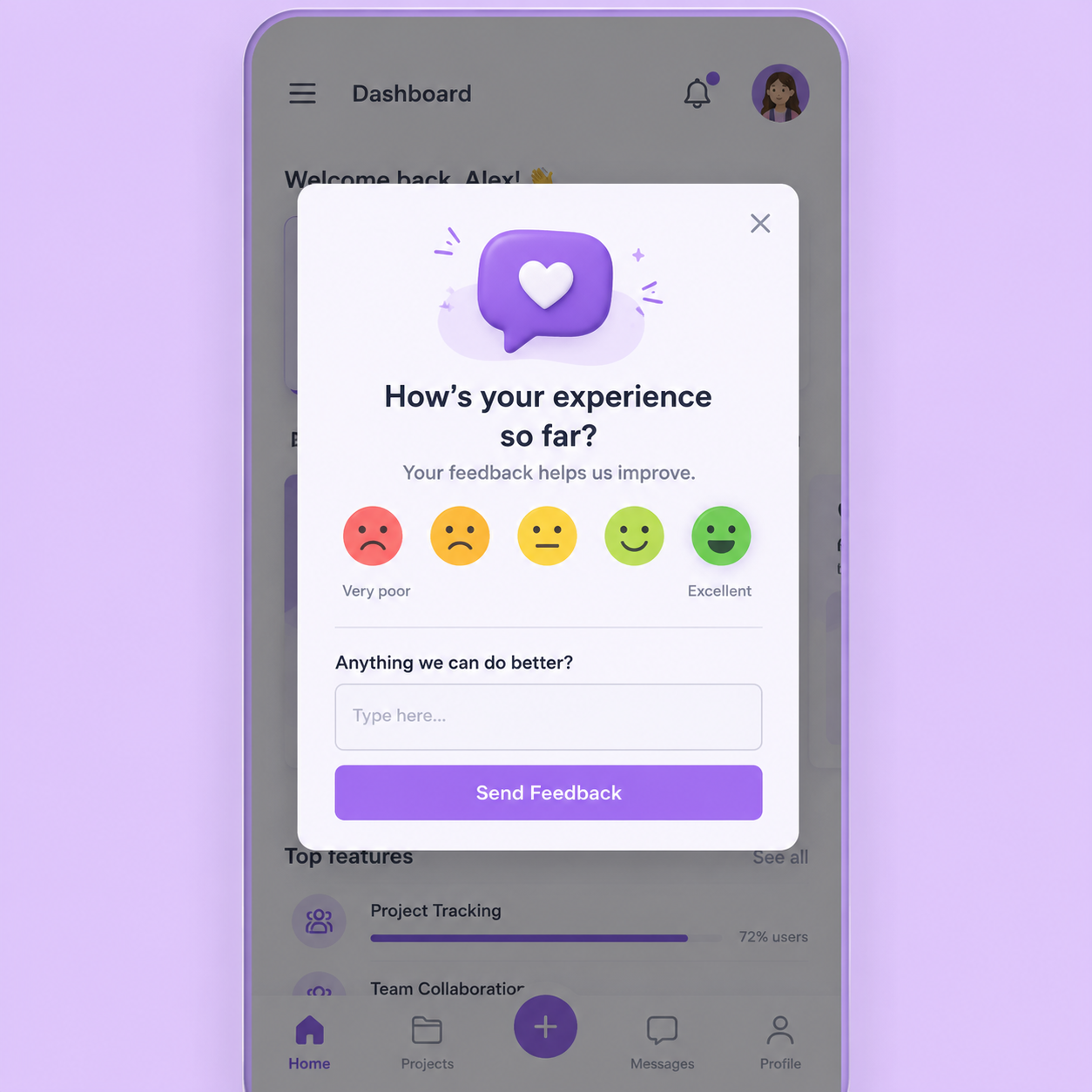
Productlogz makes this easy to manage. It lets you embed surveys directly into your product flow and collect responses in real-time, so you are not waiting weeks to learn something your users already know. Responses feed straight into your feedback dashboard alongside input from every other channel.
If in-app surveys are the broad net, customer interviews are the deep dive. They are one of the most valuable methods for getting user feedback, especially during product discovery or when you need to understand why a metric is moving in the wrong direction.
Here are a few things that make a real difference:
If you've ever been asked, "How likely are you to recommend us to a friend or colleague?" you've taken an NPS survey. At first glance, it looks like a simple rating question. But the magic isn't in the score, but in what users say next.
So, when someone gives you a low score, you get a chance to uncover frustrations before they turn into churn. However, when they give you a high score, you've found a potential advocate who may be willing to leave a review or refer others to your product.
Think of NPS as more than a number. It's a quick way to identify your happiest customers, your most frustrated users, and the reasons behind both. That's why the follow-up question is often more valuable than the score itself.
Focus groups get a bad reputation in tech circles, but they are genuinely useful for prototype testing, early-stage validation, and gathering feedback on redesigns. The advantage is dynamics: users respond to each other's comments, which often surfaces insights a one-on-one interview would miss entirely.
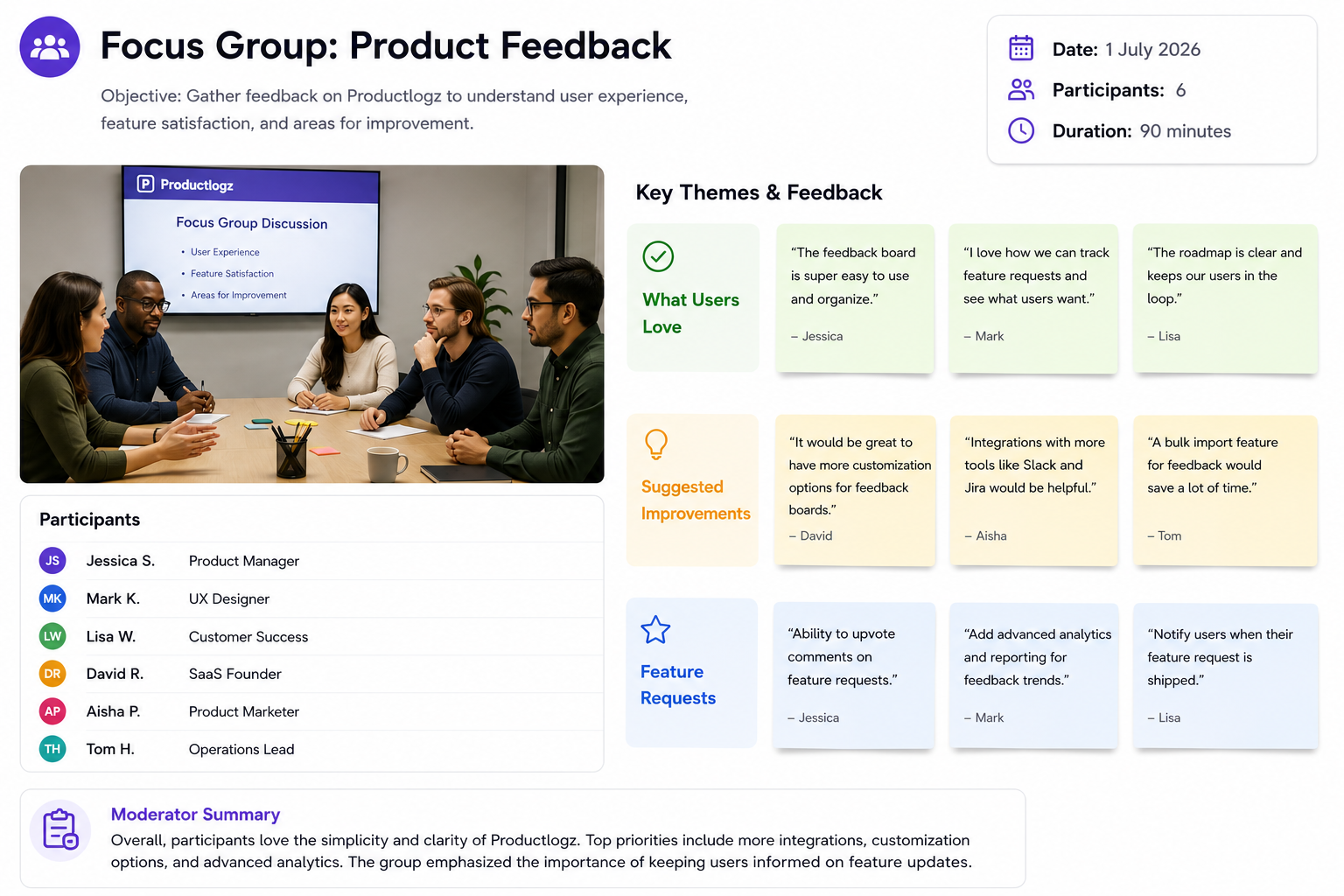
Keep groups small, between five and eight participants, and go in with a clear objective. Are you validating a concept? Testing a specific feature? Comparing two design directions? Without a focused goal, the session tends to drift, and the output becomes hard to act on.
For B2B products especially, focus groups with power users or early adopters can give your product team a week's worth of insight in a single two-hour session.
Usability testing is feedback in action. Instead of asking users what they think, you watch what they do. This matters because users are notoriously unreliable at predicting their own behaviour. They will tell you a feature is intuitive and then completely ignore it in practice.
Session recording tools let you capture exactly where users drop off, where they hesitate, and which flows they abandon. This is valuable post-MVP, when you need to know whether users are following the journeys you designed.
Sometimes users have something to say but are not going to fill out a full survey to say it. Feedback buttons solve this by putting a low-friction entry point directly inside your product.
A simple thumbs up or thumbs down, a star rating, or even a row of emojis at the end of a feature gives users a way to register their experience without disrupting their flow. These micro-signals add up quickly. Over time, they show you which features are landing and which ones are quietly frustrating people.
Your users are already talking about your product. Whether you are listening is a different question entirely. Social media platforms, subreddits, LinkedIn comments, and community Slack groups are full of unsolicited feedback. It is valuable precisely because it is unfiltered. Users are not trying to help your product team. They are just venting, celebrating, or asking questions.
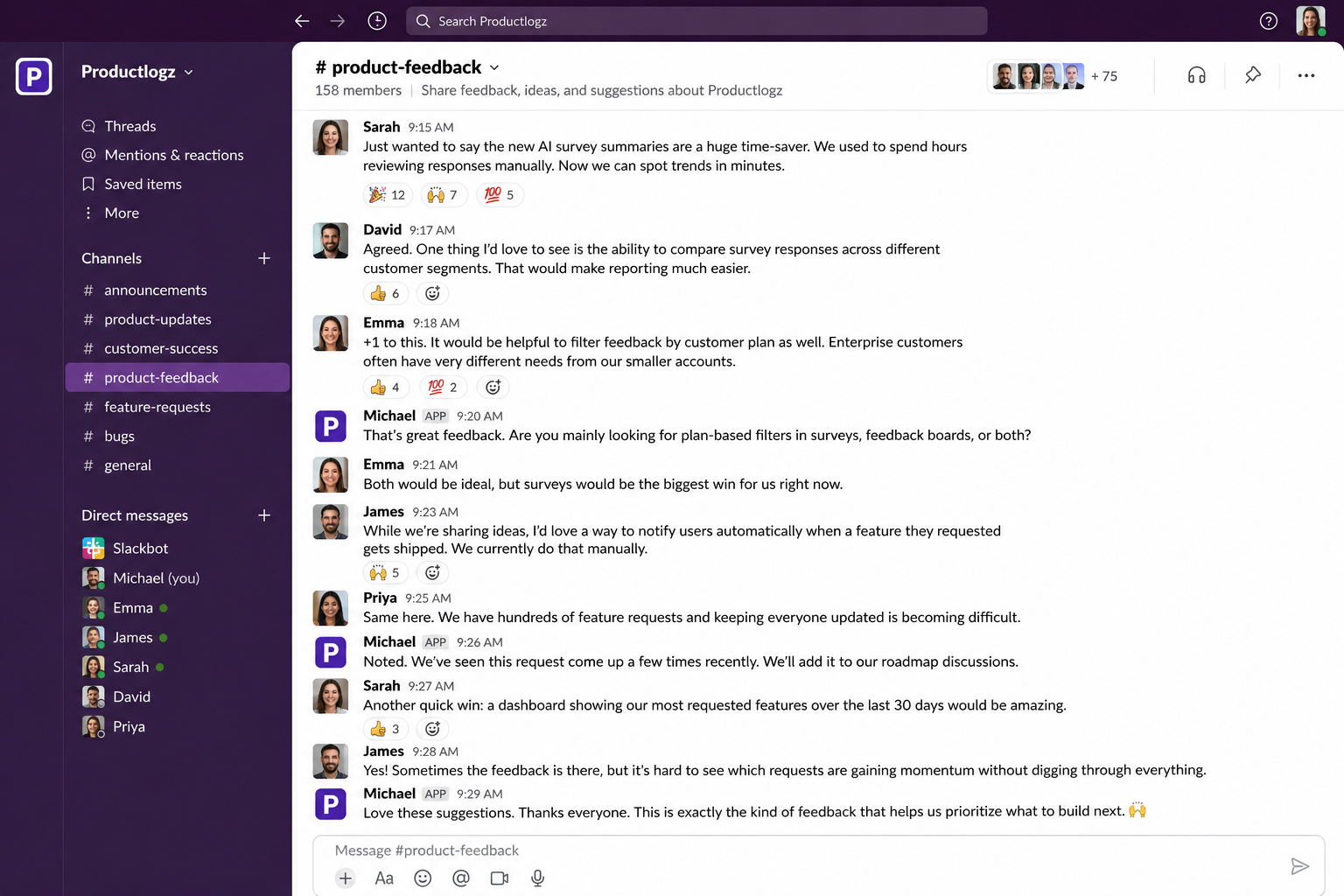
Social listening tools help you track brand mentions, spot emerging complaints, and identify feature requests you never thought to ask about. One important caveat: social feedback skews toward the extremes. Very happy users and very unhappy ones are the most vocal. Treat it as a directional signal rather than a representative sample.
A public roadmap does double duty. It shows users you have a plan, and it becomes a passive feedback collection system that runs continuously. When users can upvote feature requests and leave comments on roadmap items, you get an ongoing stream of prioritisation data without sending a single survey.
For B2B SaaS especially, this approach works well. Enterprise customers want transparency and accountability. When a requested feature moves from "planned" to "shipped," that is a genuine loyalty moment.
Productlogz includes a public roadmap feature that lets you collect feature requests, let users vote, and keep stakeholders in the loop, all without needing a separate tool.
Every support conversation is a feedback data point. When a user contacts live chat because a feature confused them, that is feedback. When three different users ask the same onboarding question in the same week, that is a pattern worth acting on.
The challenge is making sure these insights do not stay buried in your support tool. Share feedback summaries with your product team regularly. Categorise recurring themes. Use them to inform product decisions before the same question becomes your top support ticket for the next quarter.
Even a weekly Slack message summarising the top three support themes is better than letting the signal go nowhere.
Email feedback requests are a simple way to collect valuable user insights. Instead of sending a survey, send a short, personalized email asking one question about the user's experience. This approach leads to more detailed and honest responses because it feels more personal.
Also, it works well for new customers, power users, and accounts showing signs of disengagement. Just keep the message brief and easy to reply to. Most importantly, follow up when users respond.
A/B testing is feedback without words. Instead of asking users what they prefer, you show half of them option A and the other half option B, then let behaviour settle the argument. This is ideal when your team is divided on a decision that data can resolve, like button placement, onboarding flow, feature naming, and pricing page layout.
A community around your product gives you an always-on feedback channel. User forums, Slack groups, and Discord servers create spaces where users share tips, report bugs, and request features without you having to prompt them.
Also, Reddit and Quora function as informal feedback channels. Users post honest reviews, workaround tips, and frustrations on these platforms regularly. Check them and engage thoughtfully.
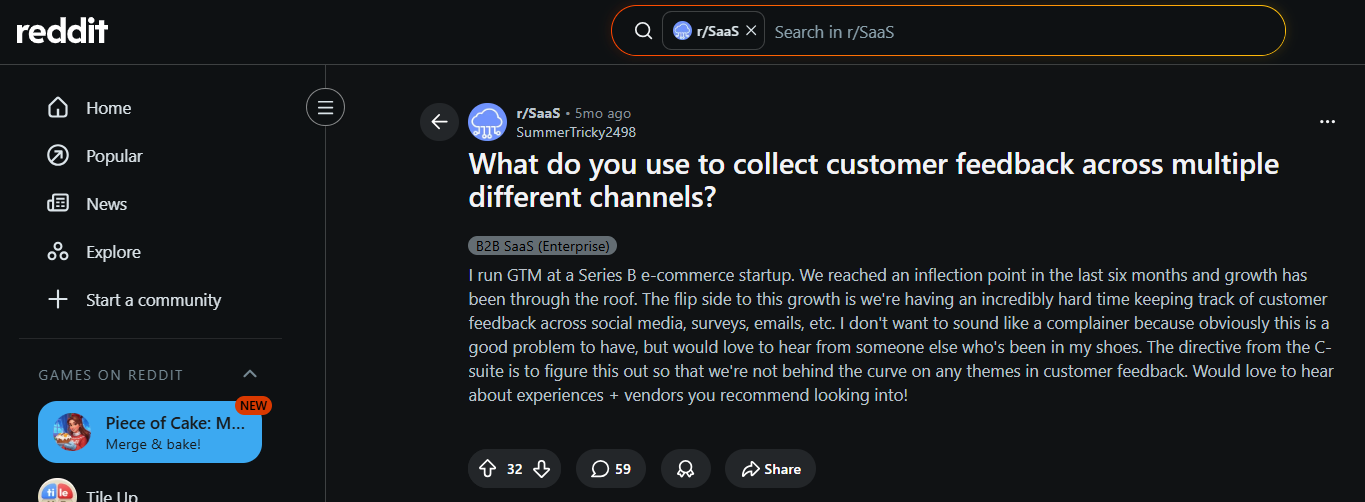
The key to making community feedback useful is closing the loop. When users see that their input shaped a product decision, they contribute more. That is how you build a continuous feedback culture rather than a one-off collection event.
Collecting feedback is the easy part. Managing it is where most teams fall short.
Collecting feedback is only half the job. You also need a way to organise, prioritise, and act on everything users share. When feedback is spread across surveys, support tickets, emails, and community discussions, important insights can easily get lost.
If you need a tool to collect, organize, and act on user feedback, Productlogz is a great option for SaaS teams. It is a user feedback management platform that helps you gather feedback from multiple channels, prioritize feature requests, and connect customer insights directly to your product roadmap.
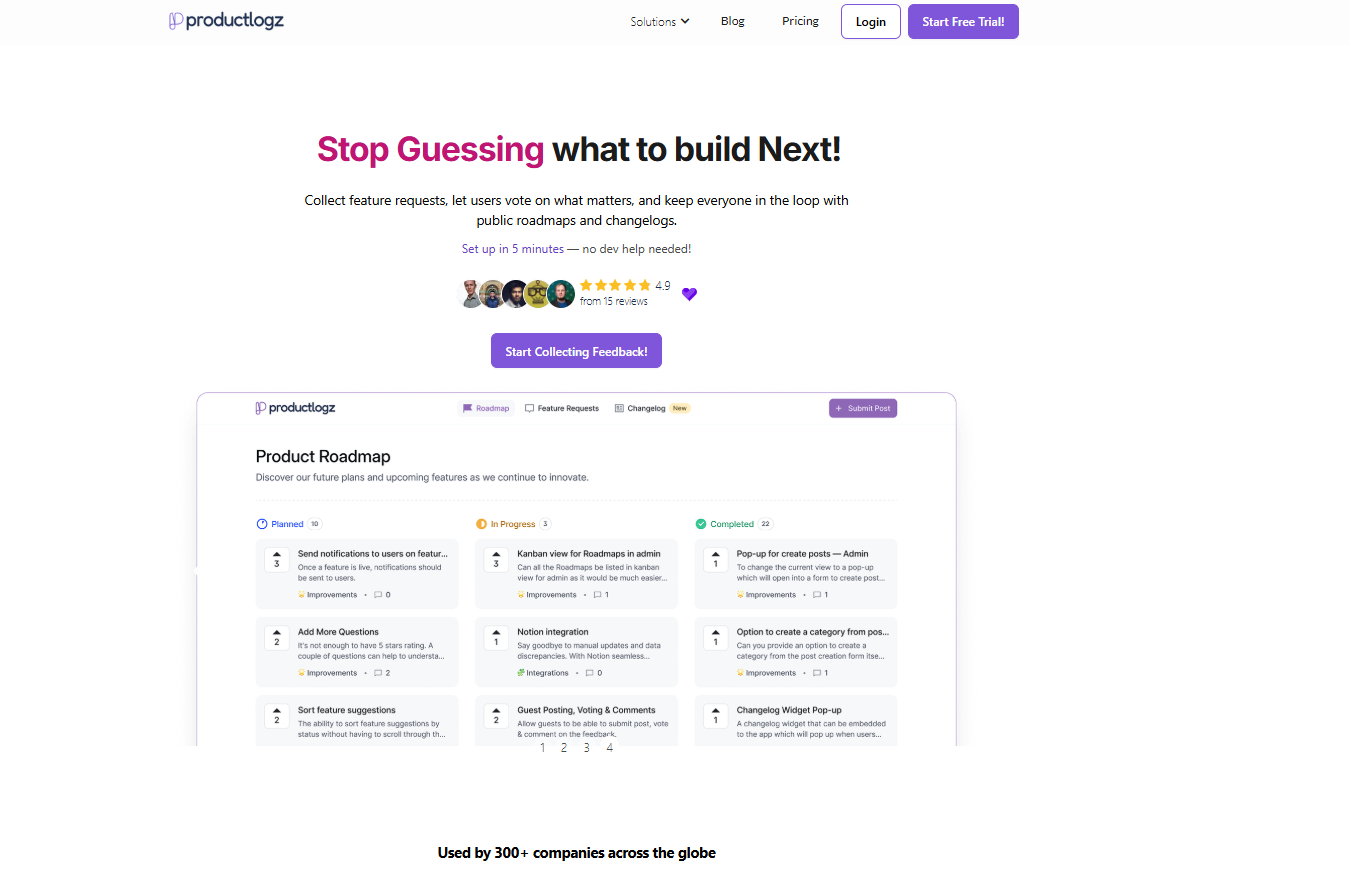
Some of the key features of Productlogz include:
Instead of managing feedback across surveys, support tickets, emails, and spreadsheets, Productlogz brings everything together in one place. This makes it easier to spot trends, understand customer needs, and make better product decisions. Ready to streamline your feedback process? Sign up for Productlogz and start turning user feedback into a product roadmap your customers will love
What is the best way to collect user feedback for a SaaS product?
The most effective approach combines multiple methods. In-app surveys work well for high-frequency quantitative data. Customer interviews go deeper on the qualitative side. Passive channels like social listening and support conversations add unsolicited signal that surveys would never capture. No single method tells the full story.
Why is it important to close the feedback loop?
Closing the feedback loop shows users that their input matters. It builds trust, encourages future participation, and helps maintain an active feedback culture.
What is the difference between qualitative and quantitative feedback?
Quantitative feedback gives you numbers like NPS scores, ratings, response distributions, and feature vote counts. On the other hand, qualitative feedback gives you context: the reasons, feelings, and stories behind those numbers.
What types of feedback are most useful for product roadmap decisions?
Feature request volume, NPS follow-up comments, and usability test findings tend to have the most direct influence on roadmap priorities.
What should I look for in a user feedback tool?
Look for a tool that centralises feedback from multiple channels and supports in-app survey deployment. The tool also needs to connect feedback to your product roadmap and let users vote on feature requests.
What should I do after collecting user feedback?
Organize feedback into categories, identify recurring themes, prioritize the most impactful requests, and communicate updates to users when changes are made.
No sales calls. No long setup. Create your workspace and start collecting feedback today.
