

What if the insight that could transform your product is already sitting in your feedback inbox? Every day, customers share feedback through surveys, support tickets, reviews, and social media. As this feedback grows, finding the insights that matter becomes increasingly difficult. As a result, product teams struggle to identify what users truly need. Interestingly, AI is changing how that works. This article breaks down exactly how AI is changing customer feedback analysis.
The bottleneck has never been collection. It has always been what comes after. A product manager reading through 3,000 open-text survey responses is not doing analysis. They are doing triage. Manual tagging is slow and inconsistent. Also, spotting patterns across channels is almost impossible without the right tooling. And by the time any of it is processed, the product has already moved on.

Volume is one part of the problem. Many apps generate hundreds of thousands of feedback touchpoints every month across support tickets, in-app surveys, app store reviews, social mentions, and direct user messages. Each channel has its own format, tone, and quirks. Now, trying to manually synthesise insights across all of them is not just inefficient. It is structurally broken.
The other part is speed. Customer expectations have shifted. Users expect that when they flag a pain point, something happens. When feedback cycles take weeks, the opportunity to act on real-time signals is already gone. That gap is where AI earns its keep.
Here are the biggest ways AI is transforming customer feedback analysis.
One of the first things businesses want to know after collecting customer feedback is simple: How do customers feel?
At first glance, this sounds like an easy question to answer. If customers leave positive reviews, they are happy. If they leave complaints, they are unhappy.
Unfortunately, real conversations are rarely that straightforward.
Traditional sentiment analysis was designed to classify feedback into three categories: positive, negative, or neutral. It looked for certain words and phrases to decide which category a comment belonged to. While this approach was useful, it often missed the bigger picture because people rarely communicate in such predictable ways.
This is where AI makes a significant difference. Instead of analyzing words one by one, AI looks at the entire sentence to understand its context. It also goes beyond asking whether customers are happy or unhappy. Many AI-powered tools can detect a much wider range of emotions, including frustration, confusion, disappointment, excitement, relief, and delight.
That extra level of understanding gives businesses much richer insights. Of course, understanding how customers feel is only the first step.
The next challenge is making sense of thousands, or even millions, of comments coming from different places every single day.
Imagine launching a major product update. Within a few days, customers begin sharing their opinions everywhere. Some complete a feedback survey. Others contact customer support. Many leave reviews on the App Store or Google Play. A few discuss the update on X, LinkedIn, Reddit, or other social platforms.
Then, imagine sitting down to read every single comment. Even if your company receives only a few hundred responses each day, reviewing them one by one would become exhausting. For larger businesses, that number could easily grow into tens of thousands of comments every week.
Now, AI can organize feedback from multiple channels into one central view. Instead of analyzing survey responses separately from support tickets or app reviews, businesses can see the complete customer story in one place.
Once AI has grouped similar feedback, the next challenge is making sense of it all. Reading thousands of customer comments is simply not practical, especially for fast-growing businesses.
Instead of asking teams to review every survey response, support ticket, or app review, AI can generate a short summary that highlights the biggest takeaways. For example, after analyzing thousands of comments about a recent product update, AI will report that customers love the new design but are frustrated by slower loading times and are requesting a dark mode.
These summaries save hours of manual work while making sure important insights are not overlooked. Product managers can easily understand what customers are saying without spending days reading individual comments. Many AI tools can even generate weekly or monthly reports that show how customer opinions are changing over time.
Customer feedback changes constantly. A product update, pricing change, or new feature can completely shift customer opinions within hours.
If businesses only review feedback at the end of the week or month, they may discover problems long after customers have started experiencing them.
AI solves this by monitoring feedback as it comes in. Instead of waiting for someone to notice a pattern, the system automatically detects when more customers begin talking about the same issue.
Let’s say a new software update accidentally introduces a login bug. Within a few hours, support tickets, app reviews, and social media posts all begin mentioning login failures. AI can spot this growing pattern almost immediately and alert the product team before the issue affects even more users.
The same applies to positive feedback. If customers suddenly praise a newly released feature, AI highlights that trend as well, helping businesses understand what's working just as it identifies what's not.
Knowing what customers are complaining about is helpful, but knowing why they are complaining is even more valuable.
This is where AI supports root cause analysis, which simply means finding the underlying reason behind a problem.
For example, customers may repeatedly complain that the checkout process is frustrating. At first, that sounds like one large issue. However, after analyzing thousands of comments, AI may discover that most complaints relate to slow page loading, payment failures, or unexpected shipping costs.
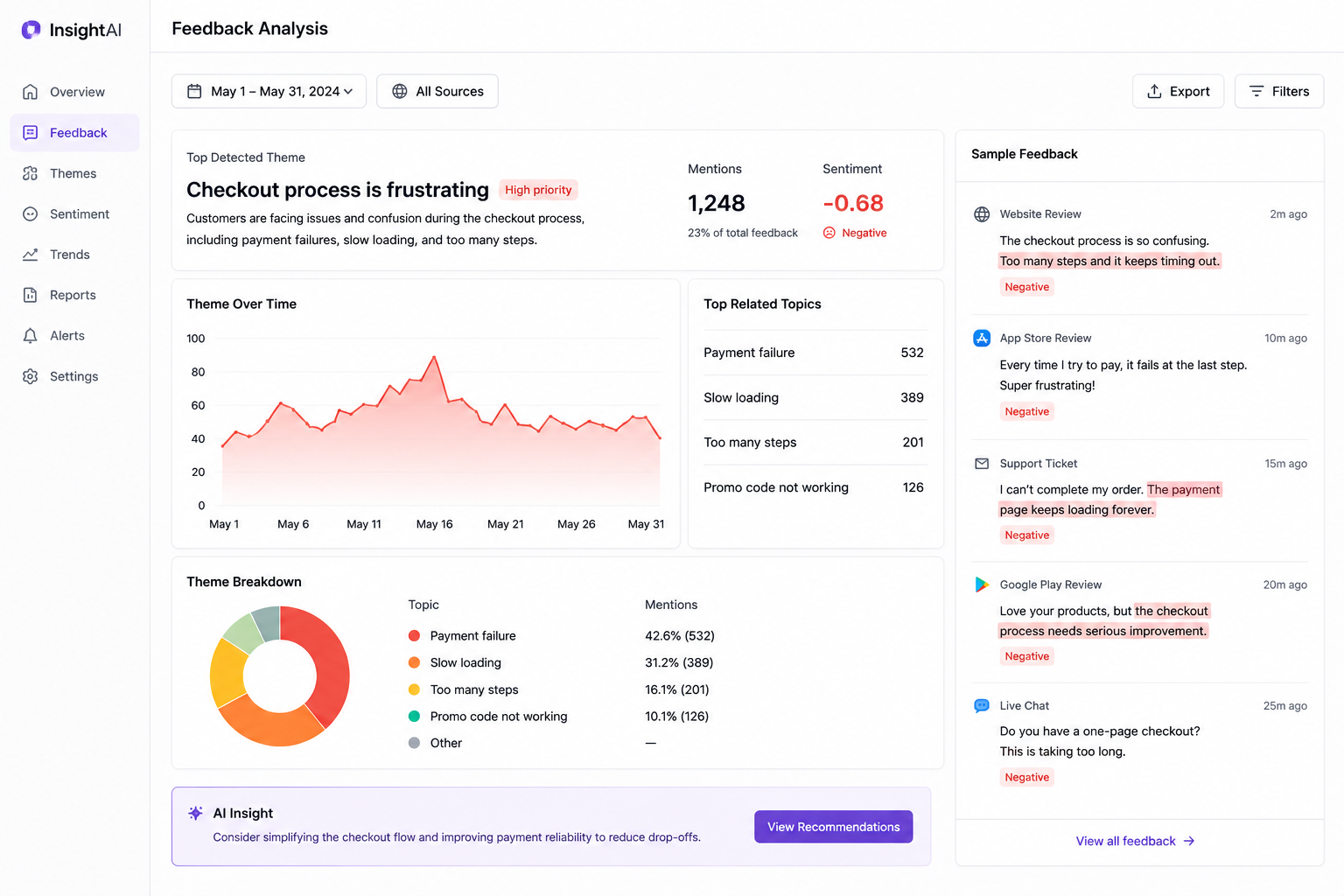
By connecting similar feedback and identifying common causes, AI helps teams focus on fixing the real problem instead of treating every complaint as a separate issue.
Every day, businesses receive more feedback than they can act on. Some comments point to critical bugs, while others suggest small improvements or new feature ideas.
The problem is deciding what deserves attention first. AI helps by prioritizing feedback based on factors such as how often an issue appears, how serious it is, how many customers are affected, and whether it could increase the risk of customers leaving.
For example, ten customers requesting a new color theme may not be as urgent as hundreds of customers reporting that they cannot complete a payment. While both pieces of feedback matter, AI helps teams understand which issue will have the biggest impact if addressed first.
Customer feedback becomes even more valuable when it is combined with customer behavior. Instead of only looking at what people say, AI can also analyze how they use a product. This includes login frequency, feature usage, support interactions, and survey responses.
By bringing all this information together, AI can identify customers who may be at risk of leaving. This process is known as predictive analytics.
For example, if a customer starts using the product less often, submits several negative support tickets, and leaves poor survey ratings, AI can flag them as someone who may be considering other options.

Finding patterns in customer feedback is important, but it is only part of the process. Businesses also need to decide what to do next.
Modern AI goes beyond identifying problems by recommending possible solutions based on the feedback it analyzes.
For example, if customers repeatedly say they cannot find a particular feature, AI might suggest improving the navigation, simplifying the interface, or updating the onboarding experience. If users frequently ask the same question, it may recommend creating a help article or improving existing documentation.
One of the biggest reasons AI has become so effective at analyzing customer feedback is its ability to understand the way people naturally communicate. This is made possible by Natural Language Processing (NLP), a branch of AI that helps computers understand and interpret human language.
Customers rarely write feedback perfectly or consistently. Some use slang, abbreviations, emojis, or incomplete sentences. Others make spelling mistakes or switch between different topics in a single comment. Despite this, modern AI can still understand the main message.
For example, a customer might write, "Love the new update, but checkout is kinda slow lol." Even though the sentence is informal, AI can recognize that the customer appreciates the update while also highlighting a performance issue during checkout.
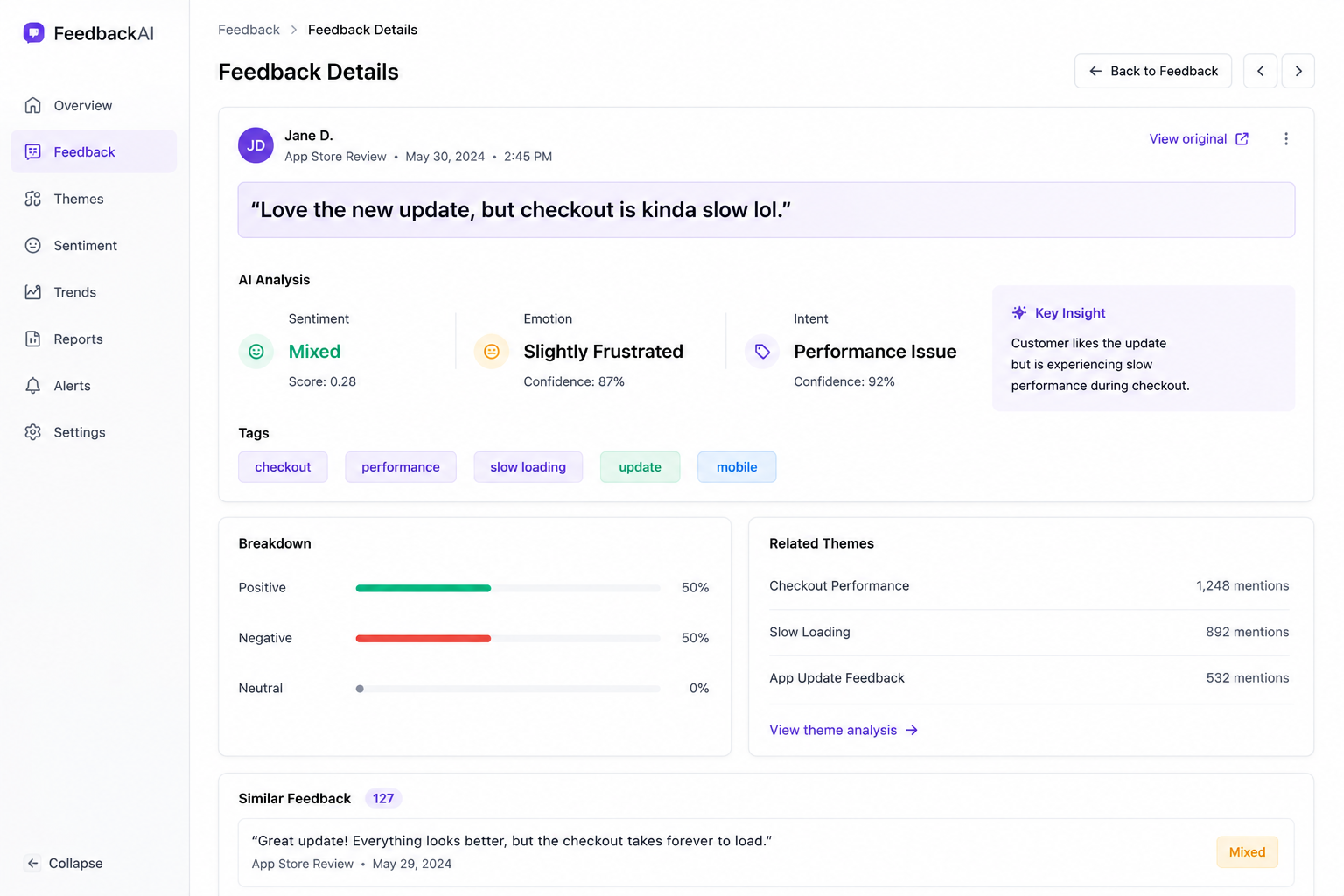
Collecting feedback is only useful if the insights are shared with the people who can act on them. Product managers, executives, customer success teams, and support leaders all need a clear picture of what customers are saying.
This is where Voice of the Customer (VoC) reporting comes in. Voice of the Customer is the process of collecting and presenting customer feedback in a way that helps businesses understand customer needs, expectations, and pain points.
Rather than manually building reports from different data sources, AI automatically creates summaries that highlight the most important insights. These reports can show the biggest customer complaints, the most requested features, changes in customer sentiment, and emerging trends over time
A few simple practices can improve the quality of the data entering your feedback system. To get the best result, you need to:
When feedback is collected thoughtfully, AI can identify patterns more accurately and provide recommendations that are more valuable for product and customer experience teams.
After collecting feedback, analysing it with AI, and identifying the right actions, the next challenge is bringing everything together in one workflow. That's why you need Productlogz.
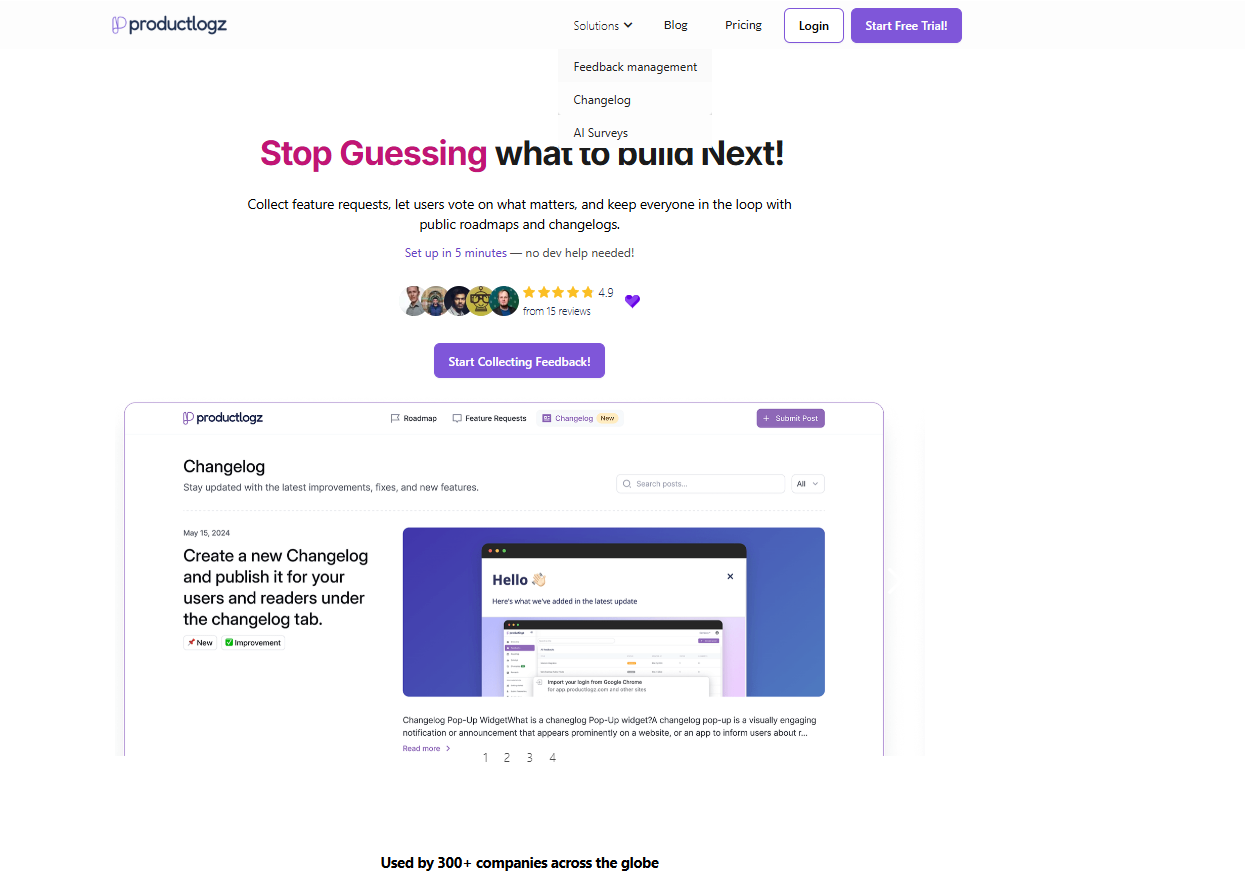
Productlogz is a customer feedback management platform designed to help product teams collect, organise, analyse, and act on user feedback from a single place. For teams that want to validate product decisions, run AI-powered surveys, or track satisfaction metrics over time, Productlogz brings it all together. Sign up today and see how much signal you have been leaving on the table.
What is AI-powered customer feedback analysis?
AI-powered customer feedback analysis uses machine learning and natural language processing to automatically read, tag, and interpret customer feedback.
What types of businesses benefit most from AI feedback analysis?
Any business with high feedback volume benefits, but it is especially valuable for SaaS products, mobile apps, and e-commerce platforms where user feedback arrives across multiple channels simultaneously.
Can AI replace human analysis of customer feedback?
No. AI handles volume, pattern detection, and real-time alerting well. However, understanding the why behind feedback, making product decisions, and communicating findings across teams still requires human judgement.
Can AI analyze open-ended survey responses?
Yes. AI can process large volumes of open-text responses and identify common topics, sentiment, and patterns. This allows teams to uncover insights from qualitative feedback without manually reading every comment.
Can AI analyze customer feedback in real time?
Yes. Many AI tools process feedback as it arrives, allowing businesses to detect emerging issues, monitor product launches, and respond to customer concerns more quickly.
No sales calls. No long setup. Create your workspace and start collecting feedback today.
